
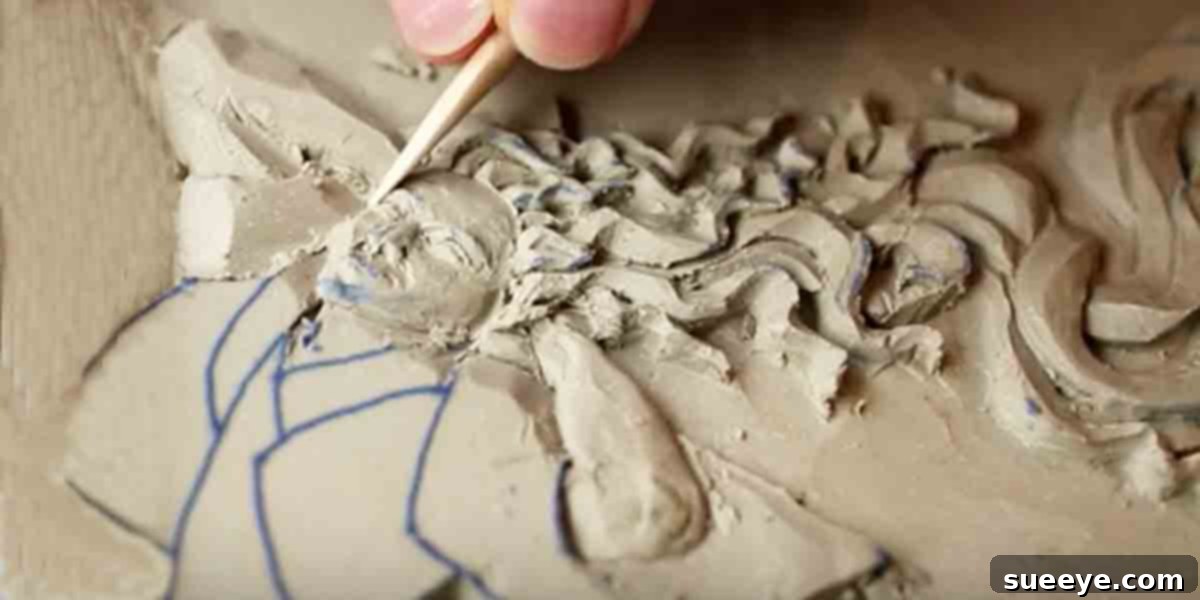
Unlocking the Art of Bas Relief Clay Carving: Inspired by Victoria Ellis
The timeless allure of clay art captivates countless enthusiasts, offering a unique medium to transform raw material into breathtaking masterpieces. Imagine taking a simple lump of humble clay and, through careful design and skilled hands, shaping it into a magnificent, three-dimensional artwork. This incredible journey from raw material to refined art is precisely what renowned British artist Victoria Ellis masterfully demonstrates in her fascinating bas relief figurative clay murals. Her process, an inspiring blend of precision and passion, illuminates the vast potential of this ancient craft, making it approachable and exciting even for those new to the world of ceramics.
Witnessing Victoria Ellis at work is an artistic revelation. Her methods, which include meticulously tracing a design, skillfully transferring it to clay, and then carving with extraordinary detail, culminate in truly beautiful pieces of art. The attached tutorial offers a compelling documentary film that showcases her entire creative process, from the initial design concept right through to the final glazed mural. It’s an unparalleled opportunity to observe how she carves the clay using her custom-modified tools and discovers her ingenious methods for preparing and applying glazes that bring her sculptures to life.
What is Bas Relief Clay Art?
Bas relief, derived from the French term for “low relief,” is a sculptural technique where forms project only slightly from the background, creating a subtle yet powerful three-dimensional effect without fully detaching from the surface. This captivating art form boasts a rich history, originating in antiquity with intricate carvings adorning the monuments of ancient Egypt, to the majestic friezes of Greece and Rome, and continuing through various cultures and epochs.
Unlike high relief, where figures stand out boldly and often appear almost in the round, bas relief relies on nuanced variations in depth to convey detail, perspective, and emotion. It is a delicate dance between two-dimensional drawing and three-dimensional sculpture, offering artists a unique medium for storytelling and aesthetic expression. Clay, with its inherent malleability and responsiveness, proves to be an ideal material for bas relief, allowing for the creation of intricate details, smooth transitions, and nuanced textures that bring designs vividly to life. It’s a technique that allows for a profound sense of depth and realism, making the surface dynamic and engaging.
The Master’s Touch: Victoria Ellis and Her Figurative Murals
Victoria Ellis elevates bas relief clay carving to an extraordinary art form, distinguished by its intricate detail and profound artistic expression. Her tutorial isn’t just a simple demonstration; it’s an insightful documentary, meticulously detailing every step of her creative process. From the initial spark of an idea to the complex layering of glazes, viewers are granted a privileged, in-depth look into the world of a master artisan. This deep dive into her techniques makes the seemingly complex process feel achievable for aspiring artists.
Her method begins with the development of a compelling design. Victoria emphasizes the critical importance of a clear and precise vision, often translating her initial concept into a detailed drawing. This drawing isn’t merely a preliminary sketch; it becomes the exact blueprint for the sculptural journey. The true magic unfolds as she meticulously transfers this intricate design onto a prepared clay slab, ensuring every line and contour is faithfully reproduced as the foundation for her carving.
Using a collection of specialized, often custom-modified tools—a testament to her dedication to precision and efficiency—Victoria then embarks on the delicate and highly skilled task of carving. Each stroke is deliberate, purposeful, and precise, shaping the clay to bring incredible depth and form to her figurative murals. We witness the breathtaking evolution of a flat clay surface into a dynamic scene, where figures emerge with remarkable grace, expression, and narrative power. Her ability to sculpt emotion and movement into static clay is truly inspiring.
Beyond the carving, Victoria’s expertise extends profoundly to the preparation and application of glazes. This final, critical stage is where the artwork truly transforms. The glazes not only provide essential protection to the fired clay but also dramatically enhance the carved details, adding vibrant color, subtle translucence, and lustrous finishes that complete and elevate the piece. Her careful selection and strategic layering of glazes reveal an exceptional understanding of how light interacts with form, texture, and color, bringing her sculptures to their breathtaking, finished conclusion. It’s a masterful interplay of texture, color, and light that defines her unique artistic signature.
Why Embark on Your Own Clay Carving Journey?
Many might look at Victoria Ellis’s ornate and highly refined work and feel a touch of understandable intimidation. The intricate details and sophisticated finish can indeed seem daunting for a beginner. However, the core technique – the process of tracing a design and then carving – is fundamentally accessible and incredibly rewarding. As the initial inspiration for this piece noted, “we can all trace a design with an exacto knife, right?” This simple, empowering truth is the gateway to a profoundly satisfying and enriching artistic journey.
Consider children, for instance. They approach clay with an uninhibited curiosity, shaping, pinching, and molding without a second thought for perfection or judgment. Their creations, often wonderfully imaginative and unburdened by conventional rules, highlight the inherent joy, freedom, and therapeutic qualities of working with clay. Why should adults be any different? The enduring beauty of clay art lies precisely in its forgiving nature and the boundless freedom it offers for experimentation, self-expression, and pure creative play.
More Than Just a Craft: The Therapeutic Benefits of Clay
Embracing a hands-on project like bas relief clay carving offers numerous and profound benefits. It significantly hones fine motor skills, encourages deep patience, and fosters a unique and powerful connection between mind and hand. The tactile experience of working with clay is inherently calming and meditative, allowing for a focused state that can relieve stress and promote mindfulness. The process of transforming a two-dimensional idea into a tangible, three-dimensional object is incredibly satisfying, boosting self-confidence and providing a concrete, visible representation of your creative efforts. It’s not merely about the final piece; it’s about the enriching, meditative journey of creation itself.
From Flat Design to Three-Dimensional Art
Furthermore, bas relief provides an excellent and approachable introduction to sculptural principles without the complexities often associated with working fully in the round. You learn crucial concepts about form, shadow, texture, and composition on a relatively flat plane, making it an ideal stepping stone for aspiring sculptors or anyone looking to expand their artistic repertoire. It allows you to develop a keen eye for detail and an understanding of how light interacts with form, skills that are transferable across many artistic disciplines. The ability to create depth and illusion on a surface offers endless creative possibilities, making each project a unique exploration.
Your First Step: A Beginner’s Guide to Bas Relief Clay Carving
Inspired by Victoria Ellis’s masterful demonstration, you might be eager to get your hands on some clay and begin your own artistic journey. But where exactly do you begin? Here’s a simplified, step-by-step guide to starting your own bas relief project, designed to demystify the process and make it accessible and enjoyable for everyone, regardless of prior experience.
Choosing the Right Clay for Your Project
Selecting the appropriate clay is the first crucial step. For absolute beginners, air-dry clay is an excellent and highly recommended starting point. It requires no firing, eliminating the need for a kiln, making it incredibly convenient, mess-free, and budget-friendly. While it may not offer the same durability or finish as kiln-fired ceramic clay, it allows you to practice fundamental techniques, understand the medium’s behavior, and develop your carving skills without specialized equipment. Polymer clay is another fantastic and versatile option; it hardens reliably in a regular home oven, comes in a wide spectrum of colors, and holds intricate details beautifully.
If you have access to a kiln or a local pottery studio, traditional ceramic clays such as earthenware or stoneware are classic and professional choices for bas relief. These clays provide superior strength, durability, and a wide range of aesthetic possibilities, especially when paired with true ceramic glazes, offering a professional and long-lasting finish that truly showcases your artistic efforts.
Essential Tools for Bas Relief Sculpting
Having the right tools makes all the difference. An exacto knife (as suggested in the original inspiration) is absolutely crucial for precise cutting, incising fine lines, and creating sharp edges in your clay. Beyond that, a basic set of clay modeling tools will prove invaluable. These sets often include various loop tools, ribbon tools, and wooden sculpting tools, which are perfect for scraping, smoothing, detailing, and adding subtle textures to your work. A sturdy rolling pin is essential for creating an evenly thick clay slab, providing a consistent base for your relief. A small, soft sponge is also useful for gently smoothing surfaces and blending areas.
Victoria Ellis herself highlights the use of custom-modified tools, a practice common among experienced artisans. As you advance and develop your own unique carving style, you might find yourself adapting existing tools or even crafting new ones to perfectly suit your specific needs and preferred techniques, further personalizing your artistic process.
Developing Your Design: From Concept to Clay
Start with a relatively simple design for your first bas relief project. Geometric patterns, stylized leaves, simple floral motifs, or even basic figurative outlines are perfect for a beginner. Sketch your chosen design clearly on paper. Remember, this will serve as your primary guide, so clarity and precision in your drawing are absolutely key. Don’t hesitate to seek inspiration from nature, art history, or various online resources.
Once your design is finalized and you’ve selected your clay, roll out a slab to an even thickness. Typically, a thickness of between 1/4 to 1/2 inch is ideal, depending on the desired depth and prominence of your relief. Ensure the surface is as smooth as possible, using a damp sponge to remove any imperfections or inconsistencies. A well-prepared slab is the foundation for a successful carving.
Transferring Your Vision to the Clay Slab
There are several effective methods for transferring your paper design onto the prepared clay slab. You can gently place your paper design directly onto the clay and carefully trace over the lines with a sharp pencil or a stylus, applying just enough pressure to make a light impression without deforming the clay. Alternatively, for a clearer and more defined transfer, you can use carbon paper placed between your design and the clay. For more confident and experienced artists, sketching directly onto the clay with a fine-tipped carving tool is also a viable and spontaneous option. Whichever method you choose, accuracy in transfer is vital.
Mastering the Carving Techniques
This is the moment where your two-dimensional design truly begins its transformation into a three-dimensional artwork. Begin by meticulously incising the main outlines of your design using your exacto knife or a fine-tipped carving tool. Once the primary contours are established, start carefully removing clay from around your design to create the desired relief effect. Remember to work slowly, deliberately, and in small increments. Patience is your greatest tool here.
You can create various levels of depth within your relief – areas that you want to stand out more prominently will require more clay to be removed from their surrounding areas. Utilize your loop tools to scoop out larger sections and use smaller, finer tools for intricate details, textures, and subtle modeling. Don’t be afraid to experiment with adding texture; you can create lines, stippling, cross-hatching, or other patterns to different elements of your design to enhance visual interest and realism.
Throughout the carving process, it’s crucial to keep your clay hydrated. Lightly misting it with water occasionally, especially if you’re working on a larger piece over an extended period, will prevent it from drying too quickly and cracking. Maintaining consistent moisture allows for smoother carving and prevents damage.
The Finishing Touches: Drying, Firing, and Glazing Your Work
Once your carving is complete, the drying process is paramount. Allow your piece to dry very slowly and evenly. This ‘greenware’ stage is crucial for preventing unsightly cracks and warping. Begin by covering your piece loosely with plastic for the first few days, gradually exposing it to air over a period of a week or even more, depending on its size and thickness. Slow drying ensures uniform moisture evaporation.
If you opted for air-dry clay, simply follow the manufacturer’s instructions for complete drying, after which you can paint it with acrylics and apply a sealant for protection. For polymer clay, bake it in a conventional oven according to the package directions.
If you’re working with traditional ceramic clay, after it is bone dry, it will undergo a ‘bisque firing’ in a ceramic kiln. This initial firing hardens the clay and prepares it for glazing. After bisque firing, you can apply ceramic glazes, following Victoria Ellis’s exemplary techniques, and then fire it again to achieve a beautiful, durable, and lustrous finish. This final glaze firing transforms your carved clay into a permanent work of art, shining with depth and color.
Embrace the Creative Process: Your Clay Art Journey Awaits
The journey of creating a bas relief clay mural, deeply inspired by the mastery and dedication of artists like Victoria Ellis, is a profoundly personal and incredibly rewarding one. It’s an invitation to slow down, to engage deeply with a tactile medium, and to witness the remarkable magic of your own hands bringing a vision to tangible fruition. This creative process is not just about making art; it’s about self-discovery and the joy of creation.
Do not let the apparent complexity of advanced works deter you from starting. Every master artist began somewhere, often with a simple trace, a basic tool, and a keen, unwavering desire to create. Grab some clay, watch how Victoria Ellis masterfully transforms her intricate ideas into tangible beauty, and embark on your own unique artistic adventure. The world of clay art, rich with texture, form, and boundless potential, awaits your unique touch and creative spirit. Let your hands tell your story through the timeless medium of clay.