
Are you tired of cluttered closets, overflowing drawers, and the constant struggle to find what you’re looking for? If your wardrobe feels more like a chaotic jumble than an organized haven, you’re not alone. Many of us grapple with limited storage space, but the secret to reclaiming your closet isn’t always about buying more furniture; it’s about mastering the art of efficient clothing storage. The brilliant minds at Creative IDEAS on YouTube are here to transform your approach, showing you innovative techniques that unlock an surprising amount of hidden storage capacity right where you need it most. Prepare to be astonished at how much room you truly possess when you learn the proper methods for folding and storing your clothes with precision and care. For a comprehensive visual guide, make sure to watch their detailed video instructions below.
Embracing a systematic approach to folding and organizing your clothes offers far more than just a tidier space. It’s an investment in your daily routine, your garments’ longevity, and even your peace of mind. Imagine opening a drawer and instantly seeing every item, wrinkle-free and perfectly accessible. This isn’t just a dream; it’s an achievable reality. Proper folding techniques minimize creases, which means less time spent ironing and more time enjoying your clothes. It protects fabrics from stretching and damage, extending the life of your favorite pieces. Furthermore, an organized wardrobe reduces decision fatigue, making getting ready a swift and stress-free experience. By adopting these methods, you’re not just organizing clothes; you’re cultivating a more mindful and efficient lifestyle.
How to Fold and Store Clothes the Right Way: A Comprehensive Guide
Revolutionizing your closet begins with understanding the specific needs of each garment. From the smallest socks to the bulkiest hoodies, there’s a technique that maximizes space and maintains integrity. This guide will walk you through precise, easy-to-follow steps for folding various clothing items, ensuring a neat, accessible, and highly efficient wardrobe. Get ready to transform your storage challenges into triumphs of organization.
1. Mastering Sock Folding for Optimal Space
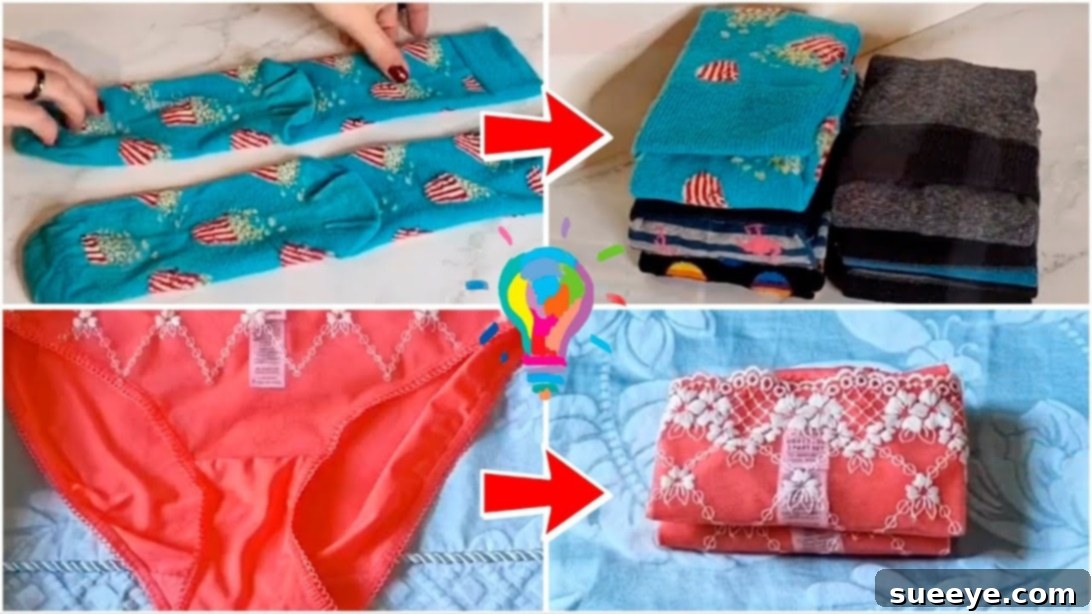
Socks, often considered a minor item, can quickly become a tangled mess, consuming valuable drawer space. The key to efficient sock storage lies in a method that keeps them paired, compact, and easily identifiable. Begin by taking both socks and straightening them out completely. Lay them flat on a clean surface, ensuring the heels and toes are aligned perfectly, with the back sides (the inside of the sock) facing up. Next, place one sock directly on top of the other, aligning them as precisely as possible. This creates a single, double-layered unit. Take the bottom edge of the combined socks and fold it upwards, bringing it more than halfway towards the top edge. Ensure this fold is crisp and even. Then, take the top part of both socks and fold it downwards, aiming to meet precisely where the first fold ends. Finally, and this is the ingenious part, locate the opening created by the initial fold of the bottom sock. Gently tuck the newly folded bottom segment into this opening. This creates a neat, self-contained packet that stands upright in a drawer, making selection effortless and preventing runaway single socks. This method works wonderfully for ankle socks, crew socks, and even some knee-high socks, though longer socks may require an additional fold before the final tuck.
2. The Art of Folding Men’s Underwear for Compact Storage
Keeping men’s underwear neatly organized not only saves space but also prolongs the life of the elastic and fabric. A simple yet effective folding method ensures they remain compact and wrinkle-free. Start by laying a pair of underwear flat on a clean, smooth surface, ensuring all creases are smoothed out. Imagine dividing the underwear into three vertical sections. Take one side (either left or right) and fold it inward towards the center. Repeat this process with the other side, overlapping the first fold slightly or meeting it in the middle, depending on the width of the garment. This will create a narrower, rectangular shape. Now, focus on the length. Fold the top edge (waistband) downwards towards the center. Similarly, fold the bottom edge (leg opening) upwards towards the center, meeting or slightly overlapping the previous fold. Finally, gently tuck the bottom folded part into the top folded part, creating a secure, compact square or rectangle. This method is ideal for briefs, boxers, and boxer briefs, allowing them to be stored vertically in drawers for maximum visibility and accessibility.
3. Efficient Folding for Women’s Underwear
Women’s underwear, with its various styles and delicate fabrics, benefits greatly from a specific folding technique that keeps it tidy and preserves its shape. Begin by laying the underwear flat on a clean surface with the right side (the exterior) facing down. This allows for a cleaner finish on the visible side once folded. Start by folding the top part (waistband) down towards the center, aligning it with the crotch area. Next, take each side of the underwear and fold them inward towards the middle, creating a narrower, more compact shape. Ensure these side folds are neat and even. Now, fold the remaining top portion (the original top of the waistband) down towards the bottom of the garment. Finally, flip the entire folded piece over to the back. This creates a small, neat packet that can be easily stacked or stored upright in a drawer, preventing stretching and tangling, and making it simple to choose your desired pair without rummaging.
4. Perfectly Folding Long-Sleeved Polo Shirts and Similar Garments
Long-sleeved polo shirts, dress shirts, and other button-down long-sleeved garments can take up considerable space and wrinkle easily if not folded correctly. This method ensures a compact, neat result. Start by laying your long-sleeved polo shirt face down on a flat, clean surface. Smooth out any wrinkles. Take one of the sleeves and fold it diagonally or straight across the back of the shirt, aiming towards the opposite shoulder. Ensure the sleeve lies flat against the shirt body. Repeat this process with the other sleeve, laying it over the first one, or positioning it to mirror the first fold, creating a somewhat narrower silhouette. Now, fold the sides of the shirt inward towards the center, aligning them with the width you desire for your final folded garment. This creates a neat rectangular shape. Next, take the top of the shirt (collar area) and fold it halfway down towards the bottom hem. Finally, take the bottom hem and fold it up, tucking it securely into the fold created by the top part of the shirt. This method creates a compact, self-contained unit that resists wrinkling and can be easily stacked or stored vertically in drawers or on shelves.
5. The Space-Saving Roll for Polo Shirts and T-Shirts
Rolling is an excellent technique for T-shirts and polo shirts, especially for travel or when maximizing drawer space is paramount. It helps prevent wrinkles and allows for easy visibility. Begin by laying your polo shirt or T-shirt face down on a flat surface, ensuring it is completely smooth and free of wrinkles. Take one side of the shirt (e.g., the left side) and fold it inward towards the center of the shirt, bringing the sleeve along with it. The sleeve should be aligned parallel to the folded edge. Repeat this step with the other side of the shirt, folding it inward towards the center, creating a long, narrow rectangle. Depending on the size of the shirt, you might fold it in half lengthwise once more to make it even narrower if desired. Now, starting from the bottom hem of the shirt, begin to tightly roll the garment upwards towards the collar. Maintain a consistent, firm roll to ensure the final product is compact and holds its shape. This rolling method not only saves significant space but also makes it incredibly easy to see and access each shirt in a drawer without disturbing others, preventing the common problem of a messy pile.
6. Folding Jeans and Trousers for a Tidy Wardrobe
Jeans and trousers are often bulky items that can consume a lot of closet space if not folded efficiently. This simple method ensures they stay neat, compact, and ready to wear. Start by laying your jeans or trousers flat on a clean surface. Smooth out any wrinkles, paying attention to the pockets and seams. Fold the jeans in half lengthwise. This means bringing one leg over to align perfectly with the other leg, ensuring the waistband and inseams are neatly matched. Once folded lengthwise, you should have a long, narrow shape. Next, take the top part of the jeans (the waistband area) and fold it down towards the middle of the folded legs. This creates a more compact segment. Finally, take the bottom part of the jeans (the hem area) and fold it upwards, inserting it securely into the fold created by the top part. This tucking action creates a self-contained, rectangular bundle that can stand upright in a drawer or be neatly stacked on a shelf. This technique works equally well for dress trousers, chinos, and even leggings, providing a versatile solution for all your bottom wear.
7. The Hood-Tuck Method for Hoodie Jackets
Hoodie jackets, with their inherent bulk and integrated hood, can be challenging to store neatly. The hood-tuck method leverages the hood itself to create a compact, self-contained package. Begin by laying your hoodie jacket face up on a flat, clean surface. Smooth out the entire garment, ensuring the hood is also flattened and positioned at the top. Just as with long-sleeved polos, take one sleeve and fold it across the chest of the hoodie towards the opposite side. Ensure it lies flat. Repeat with the other sleeve, folding it over the first or positioning it alongside, to create a narrower body shape. Now, take the bottom hem of the hoodie and fold it upwards. Depending on the length and thickness of your hoodie, you might fold it two or three times towards the top. The goal is to create a compact rectangular body. Once the body is folded into a neat rectangle, gently take the hood and flip it inside out over the entire folded garment, effectively tucking the compact body into the hood. This creates a secure, tidy bundle that won’t unravel, making it perfect for stacking or placing in bins.
8. Simple and Effective Folding for Shorts
Shorts are generally less bulky than jeans, but they still benefit from a consistent folding method to maintain order in your drawers or shelves. This technique is quick, easy, and yields a tidy result. Begin by laying your shorts flat on a clean, smooth surface, ensuring they are free of wrinkles and the pockets are pushed in. Fold the shorts in half lengthwise, bringing one leg over to align perfectly with the other. This creates a long, narrow rectangular shape. Next, take the top part of the shorts (the waistband area) and fold it downwards towards the middle of the folded legs. Finally, take the bottom part of the shorts (the hem area) and fold it upwards, inserting it securely into the fold created by the waistband. Similar to the jeans method, this creates a compact, self-contained unit that can stand upright in a drawer or be neatly stacked, ensuring your shorts collection stays organized and easy to access.
Beyond Folding: Maximizing Your Storage Potential
While mastering folding techniques is crucial, a truly organized wardrobe goes beyond just how you fold. Consider these additional strategies to maximize your storage space and keep your clothing collection in pristine condition. Utilize drawer dividers to keep folded items separated and upright, preventing them from unraveling or shifting. Clear storage bins and baskets are excellent for containing smaller items like scarves, belts, or even off-season accessories. For items that are better hung, invest in slim-line hangers to save space on your rail. Categorize your clothes by type, color, or season to make finding outfits effortless. Regularly declutter your wardrobe, donating or discarding items you no longer wear or that are beyond repair. This ‘one in, one out’ mentality prevents your closet from becoming overcrowded again. Finally, don’t neglect vertical space! Add extra shelves, use stackable drawer units, or install over-the-door organizers to tap into unused areas of your closet or room.
Essential Tools for an Impeccably Organized Wardrobe
Equipping yourself with the right tools can significantly enhance your clothing organization efforts. Drawer dividers are indispensable for keeping folded items like socks, underwear, and t-shirts neatly sectioned and upright. Fabric or clear plastic storage bins and boxes are perfect for containing bulkier items, seasonal clothes, or accessories, keeping them dust-free and orderly. Slim, velvet-covered hangers prevent clothes from slipping and take up minimal space compared to traditional bulky hangers, allowing you to fit more on your closet rod. For off-season garments, vacuum-seal storage bags can compress bulky items like sweaters and coats, drastically reducing their volume for compact storage in attics, under beds, or in basements. Lastly, consider shelf dividers to create distinct compartments on shelves, preventing stacks of clothes from toppling over.
Common Wardrobe Organization Mistakes to Avoid
Achieving a perfectly organized wardrobe requires not only implementing effective strategies but also avoiding common pitfalls. One of the biggest mistakes is overstuffing your drawers and closets. This not only makes it difficult to find items but also damages clothes by crushing them and causing wrinkles. Another common error is neglecting regular decluttering. An organized space needs maintenance; without periodically culling unused items, clutter will inevitably return. Many people also fail to utilize vertical space, leaving valuable storage potential untapped. Ignoring the specific needs of different garments, such as hanging delicate items instead of folding them, can lead to damage. Finally, inconsistency in folding techniques can quickly lead to disarray. Strive for uniformity in how you fold each type of garment to maintain a cohesive and tidy appearance.
Transforming your wardrobe from a source of stress into a beacon of organization is an achievable goal with the right techniques and a little dedication. By implementing these ingenious folding methods from Creative IDEAS, you’ll unlock unprecedented storage capacity and discover a newfound appreciation for your clothing collection. Not only will your garments be well-preserved and easily accessible, but your daily routine will also become smoother and more enjoyable. Say goodbye to the endless search for matching socks or that favorite shirt, and embrace the serenity of a perfectly organized closet. Start applying these tips today and experience the remarkable difference for yourself – your future organized self will thank you!