
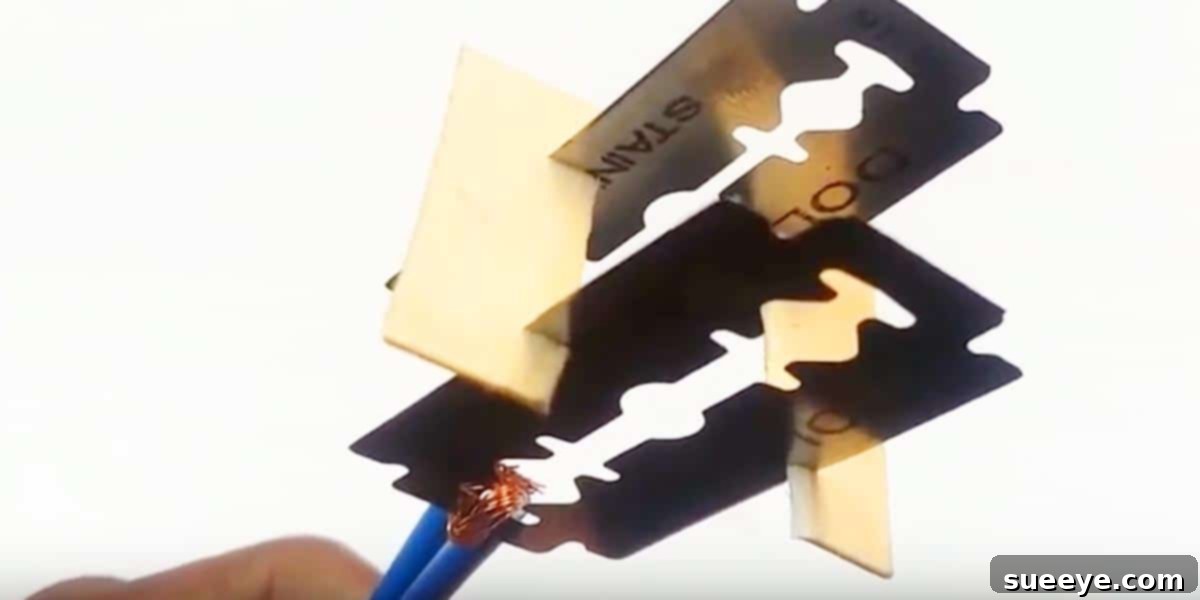
The ingenuity of humanity often shines brightest in moments of necessity, giving rise to incredibly resourceful solutions to everyday problems. Imagine a scenario where access to modern conveniences like a hot water heater is limited or non-existent. What might people devise to achieve something as fundamental as boiling water? It might surprise you to learn about a peculiar “life hack” that reportedly originated during Soviet times: a makeshift water heater crafted from a few razor blades, a popsicle stick, and a simple plug adapter. This seemingly improbable contraption claimed to heat water in minutes. While the sheer creativity behind such an idea is astounding, it immediately raises critical questions about safety, functionality, and the underlying scientific principles at play. Delving into this intriguing piece of DIY history allows us to appreciate human innovation while emphatically stressing the paramount importance of safety when dealing with electricity and water.
The Improvised Water Heater: A Glimpse into Resourceful Problem-Solving
The concept itself sounds like something out of a survival guide – and in a way, it is. The core idea involves using the conductive properties of metal razor blades to generate heat when an electric current passes through them, immersing this assembly directly into water. A popsicle stick or similar non-conductive material would be used to separate the blades, preventing a direct short circuit, while a plug adapter supplies the electricity. The story goes that this was a common method for quickly boiling water in situations where conventional heating elements were unavailable or impractical. The tutorial, often shared online, demonstrates how this simple assembly, once plugged into a power outlet, begins to heat the surrounding water almost instantly. The initial reaction for many, including ourselves, is one of disbelief and amazement that such a rudimentary setup could actually work. This immediate impact highlights the human fascination with ingenious solutions, especially those that appear to defy conventional wisdom or leverage common household items in unexpected ways.
While the notion of heating water with razor blades seems outlandish today, it underscores a historical context of resourcefulness born from necessity. In times of scarcity, whether due to economic constraints, wartime conditions, or limited infrastructure, people often had to improvise with whatever materials were at hand. This particular method reportedly gained traction in regions facing such challenges, where the ability to quickly obtain hot water for coffee, tea, or sanitation was highly valued. It stands as a testament to the human capacity for innovation, adapting readily available components to serve a basic, critical need. The fascination with this “life hack” isn’t just about its surprising effectiveness; it’s also about the historical narrative it carries, linking us to a past where ingenious, if sometimes dangerous, solutions were a part of daily life.
Understanding the Science: Resistive Heating and Electrolysis
At its core, the razor blade water heater operates on the principle of resistive heating, also known as Joule heating. When an electric current flows through a conductor, such as the metal of a razor blade, it encounters resistance. This resistance converts electrical energy into thermal energy, causing the conductor to heat up. The higher the resistance or the greater the current, the more heat is generated. In this makeshift device, the razor blades act as heating elements. As electricity from the plug adapter passes through them and then through the water (which acts as a somewhat conductive medium, especially if it contains dissolved minerals), the resistance of the blades and the water itself causes them to warm rapidly.
However, the science behind this device extends beyond simple resistive heating and introduces a far more dangerous phenomenon: electrolysis. When an electric current passes through water, particularly water containing dissolved ions (like those found in tap water), it can cause the water molecules to break down. This process, known as electrolysis, produces hydrogen gas at the cathode and oxygen gas at the anode. Both hydrogen and oxygen are highly flammable and, when mixed in certain proportions, can form an explosive mixture. In an enclosed or semi-enclosed space, the accumulation of these gases presents a severe explosion risk. Furthermore, the metal of the razor blades themselves can undergo corrosion due to the electrochemical reactions, potentially introducing undesirable substances into the water. Understanding these scientific principles is crucial, not to encourage replication, but to appreciate the underlying mechanics and, more importantly, the inherent dangers.
The Perilous Path: Why This DIY Method is Extremely Dangerous
Despite its historical curiosity and the ingenious spirit it represents, constructing and using a razor blade water heater is profoundly dangerous and strongly advised against. The risks associated with this improvised device are severe and potentially lethal, encompassing electric shock, fire, and explosion. Unlike commercially manufactured water heaters, which are designed with multiple layers of insulation, grounding, safety cut-offs, and rigorous testing, this DIY hack lacks any of these critical safety features. Plugging exposed electrical components directly into a live power source and immersing them in water creates an incredibly hazardous situation, making it one of the most perilous DIY projects imaginable.
Electric Shock: The Immediate and Fatal Threat
The most immediate and critical danger is electric shock. Water and electricity are a deadly combination. Any defect in the makeshift insulation, accidental contact with the live blades, or even the slight conductivity of the water itself can create a path for electricity to flow through your body. Standard household electricity (120V or 240V, depending on region) is more than sufficient to cause severe burns, cardiac arrest, or electrocution. The risk is amplified by the fact that the entire setup is submerged in water, which can easily conduct current to anyone touching the water or the container. There are no ground fault circuit interrupters (GFCIs) built into such a device, meaning that even a small current leakage could be fatal without immediate circuit interruption.
Fire and Explosion: A Silent Catastrophe Waiting to Happen
Beyond electric shock, the razor blade water heater poses significant risks of fire and explosion. The resistive heating process, especially with inadequate materials and uncontrolled current flow, can quickly overheat the blades and the surrounding components, leading to localized boiling and potential fire hazards. More insidiously, as discussed, the electrolysis of water produces highly flammable hydrogen gas and oxygen gas. These gases, when mixed, form a volatile combination that can easily ignite with a spark, leading to a violent explosion. The small, enclosed space of a typical container used for such a device would allow these gases to accumulate rapidly, turning a simple attempt to boil water into a potentially devastating incident. The material integrity of razor blades is also not designed for sustained electrical heating, making them prone to failure, short circuits, or further dangerous reactions.
Lack of Safety Mechanisms and Regulatory Oversight
Commercial water heaters are subject to stringent safety standards and regulations. They include thermostats to prevent overheating, pressure relief valves, insulated heating elements, and proper grounding to protect users. The razor blade heater, by contrast, has none of these. There is no control over temperature, no protection against overcurrent, and no safeguard against gas buildup. This complete absence of safety mechanisms makes it an uncontrolled and highly unpredictable device, fundamentally unsuitable for any practical application. The idea of children, or even adults without comprehensive electrical safety knowledge, attempting such a project is deeply concerning and should be actively discouraged.
Modern Water Heating Solutions: Safety, Efficiency, and Convenience
In stark contrast to such dangerous improvisations, modern water heating technology offers safe, efficient, and convenient solutions for every need. Homeowners today have a plethora of options, each designed with safety as a top priority:
- **Conventional Tank Water Heaters:** These are the most common, storing and heating a large volume of water in an insulated tank, ready for use. They feature thermostats, pressure relief valves, and robust insulation.
- **Tankless (On-Demand) Water Heaters:** These heat water only when needed, passing it over a powerful heating element (electric or gas). They offer energy savings and continuous hot water, also packed with advanced safety features.
- **Heat Pump Water Heaters:** These energy-efficient systems extract heat from the air and transfer it to the water, significantly reducing electricity consumption.
- **Solar Water Heaters:** Utilizing the sun’s energy, these systems are environmentally friendly and can drastically cut heating costs, often supplementing conventional systems.
- **Portable Camping Water Heaters:** For emergency or off-grid situations, purpose-built portable heaters exist that use propane or other fuels safely and efficiently, designed for outdoor use.
Each of these options is engineered to provide reliable hot water while adhering to strict safety standards, ensuring user protection from electrical hazards, overheating, and combustion risks. Investing in or maintaining proper, certified water heating equipment is not just a matter of convenience, but a critical aspect of home safety.
The Spirit of Innovation: When Ingenuity Meets Responsibility
The story of the razor blade water heater is a powerful reminder of human ingenuity and our innate drive to solve problems. It showcases how, in the face of limited resources, people can devise incredibly clever solutions. However, it also serves as a stark warning about the critical importance of safety and responsible engineering. While the concept might be fascinating from a historical or scientific curiosity perspective, its practical application is fraught with peril. The lesson here is not to stifle innovation, but to guide it with knowledge, safety protocols, and a deep understanding of potential consequences.
For educational purposes, discussing the *concept* of resistive heating and electrolysis, perhaps with highly controlled, low-voltage demonstrations by qualified experts, can be valuable. Such discussions can teach students about basic electrical principles, heat transfer, and chemical reactions. However, this must be done in a strictly theoretical context or with purpose-built, intrinsically safe educational kits, never replicating the dangerous razor blade apparatus with household current. The distinction between understanding a dangerous phenomenon and actively recreating it is paramount.
Conclusion: Appreciating Ingenuity with a Firm Hand on Safety
The “life hack” of the razor blade water heater is undoubtedly an intriguing piece of human history, born from a confluence of necessity, resourcefulness, and clever improvisation. It captures our imagination, demonstrating the lengths to which people will go to achieve a basic comfort like hot water, even with the most unconventional tools. Yet, this fascinating tale comes with an exceptionally strong cautionary message. The dangers associated with combining exposed electricity, water, and highly reactive materials without any safety measures are simply too great to ignore.
While we can admire the ingenuity of those who devised such methods in challenging times, it is absolutely crucial that we do not attempt to replicate them. In our modern world, safe, certified, and efficient water heating solutions are readily available. We can appreciate the spirit of innovation demonstrated by this historical hack without ever compromising on safety. Let the story of the razor blade water heater be a testament to human cleverness, but also a permanent reminder that some ingenious ideas, however fascinating, are best left as historical anecdotes and strong warnings, rather than practical DIY projects.