Navigating the world of denim can often feel like a quest, especially when the fitting room isn’t an option. Whether you’re shopping online, facing closed changing rooms, or simply prefer to save time, the challenge of finding the perfect pair of jeans without trying them on is a common dilemma. This guide is designed to empower you with simple, yet highly effective, methods to confidently choose jeans that fit flawlessly, eliminating guesswork and potential returns. We’ll delve into three ingenious hacks – the neck, forearm, and arm-span techniques – that have stood the test of time, alongside an essential tip for skinny jeans lovers. These expert strategies are your secret weapon for a seamless shopping experience, ensuring you walk away with denim that feels custom-made.
In today’s fast-paced world, and with evolving shopping habits, knowing how to accurately size clothing from a distance is more valuable than ever. From understanding your body’s unique proportions to leveraging clever measuring tricks, we’ll equip you with the knowledge to make informed decisions. Say goodbye to the frustration of ill-fitting jeans and hello to a wardrobe staple that combines comfort, style, and the perfect fit. Get ready to transform your jeans shopping strategy and embrace a smarter way to find your next favorite pair, all without ever stepping foot inside a fitting room.
1. Master the Neck Method: How to Determine Your Jeans Waist Size

One of the most widely celebrated and surprisingly accurate methods for gauging a pair of jeans’ waist size without trying them on involves a simple trick with your neck. This technique relies on the general anatomical principle that the circumference of your waist is approximately twice the circumference of your neck. To perform this hack, hold the jeans at both ends of the waistband, ensuring it’s completely buttoned and zipped up. Then, gently wrap the waistband around your neck. The goal is for one end of the waistband to comfortably meet the other end, without excessive stretching or leaving a significant gap. If the ends easily reach or even slightly overlap, the jeans are likely your size. A precise meeting point isn’t critical; a slight overlap indicates room for comfort, while a small gap suggests a snugger fit, which might still work if the denim has some stretch. This method offers a fantastic initial assessment, especially when comparing several pairs in-store or evaluating approximate sizing for online purchases. Remember, it’s a guide, but a highly effective one for quickly narrowing down your options and finding a comfortable waist fit.
The beauty of the neck method lies in its simplicity and universal applicability. It works for most body types and offers a quick way to screen potential jeans, saving you time and effort. While it primarily focuses on the waist, a well-fitting waist is often the cornerstone of a comfortable pair of jeans. For optimal results, ensure the waistband is held taut but not stretched during the measurement. This method is particularly useful when browsing through racks of denim where sizes might vary between brands, allowing you to bypass the fitting room queue and make more confident selections.
2. The Forearm Test: Defining the Perfect Jeans Width and Comfort
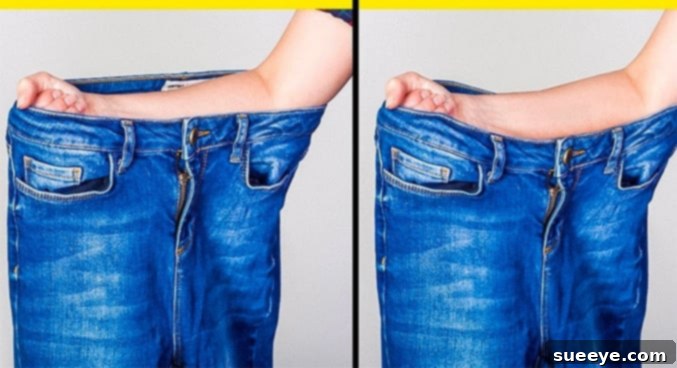
Beyond the waist, the width of the jeans around your hips and thighs is crucial for a comfortable and flattering fit. The forearm test provides an innovative way to gauge this essential dimension. To apply this hack, bend your arm at the elbow and clench your fist, creating a compact measurement tool with your forearm. Now, with the jeans zipped and buttoned, attempt to insert your clenched forearm into the waistband. If your forearm easily fits snugly into the zipped-up waistband, the jeans are likely a good width for you. This method is especially effective for jeans with a standard waist rise, as it approximates the circumference needed around the hip area for a comfortable fit.
It’s important to note a key limitation: this particular forearm test is primarily designed for standard-rise jeans. For high-waisted styles, where the waistband sits significantly higher and often narrower than the natural waist, this method may not be as accurate because the ratio between the forearm and the higher waist circumference isn’t as consistent. When trying this, ensure your forearm fits without having to force it or stretch the fabric unduly. A comfortable fit means your forearm slides in smoothly, indicating enough room for your hips and thighs without being baggy. This technique provides a quick, tactile way to assess the overall width, complementing the neck method for a more comprehensive fit evaluation.
Understanding the nuances of the forearm test can help you refine your choices. If your forearm fits too loosely, the jeans might be too wide, leading to a baggy fit. If it’s a struggle to get your forearm in, the jeans are likely too tight, restricting movement and comfort. Consider the denim’s stretch factor; a slight snugness might be acceptable in stretchy denim, as it will give over time. However, for rigid denim, aim for a comfortable fit right from the start. This method, combined with the neck test, offers a powerful duo for making informed decisions when a fitting room is out of reach.
3. The Arm-Span Length Check: Ensuring the Ideal Jeans Inseam

The length of your jeans, or the inseam, is just as critical as the waist and width for achieving the perfect look and comfort. An often-overlooked but surprisingly effective method for checking the length involves your arm span. To perform this trick, hold the very top of the waistband in one hand and the bottom hem of one leg in the other hand. Stretch your arms out horizontally to your sides as far as you can, creating a straight line with the jeans suspended between your hands. If the middle of the jeans (typically around the crotch area or the middle of the leg) hangs right under your chin at neck level, then these jeans are likely the correct length for you.
This method works by approximating the length of your legs relative to your arm span. When your arms are fully extended, the distance from your neck to your ankles roughly correlates with the midpoint of the jeans reaching your chin. This hack is particularly useful for assessing full-length jeans that you intend to wear without significant cuffing or altering. While it offers a general guide, remember that personal preference for length can vary. Some prefer jeans that just skim the floor, others prefer an ankle-length crop, and bootcut styles might require a bit more length to accommodate footwear. For precision, always consider the stated inseam measurement on the jeans’ label if available, and compare it to the inseam of a favorite pair you already own.
The arm-span length check is a fantastic tool for a quick assessment, especially when comparing several pairs in a rush. It helps to quickly eliminate jeans that are clearly too short or excessively long. For different styles, such as cropped jeans or those intended for a specific shoe height, you might adjust your interpretation slightly. However, for a standard full-length fit, this method provides a reliable starting point. Combined with the waist and width checks, you’re building a comprehensive strategy to buy jeans confidently without the need for a fitting room, making your shopping experience far more efficient and enjoyable.
Extra Tip: The Fist Test for Skinny Jeans Leg Opening
For those who love the sleek look of skinny jeans, there’s an additional hack specifically for the leg opening to ensure they’re not too tight or too loose around your ankles. This simple trick, often seen as an extension of the width measurement principles, involves using your clenched fist. Simply clench your hand into a fist and try to insert it through the leg opening of the skinny jeans. The goal is for your fist, particularly the protruding bones of your knuckles, to pass through the leg opening easily without stretching the hemline or requiring significant force. If your fist slides through comfortably, it’s a good indication that the jeans will fit well around your ankle and calf, allowing for comfortable wear and removal.
This “fist test” is particularly vital for skinny jeans because the fit around the lower leg is a defining characteristic of this style. A leg opening that’s too tight can be uncomfortable and difficult to put on, while one that’s too wide compromises the “skinny” silhouette. The natural circumference of your clenched fist provides a surprisingly accurate proxy for the circumference of your lower calf or ankle, where skinny jeans tend to be narrowest. Pay attention to how easily your knuckles pass through; if it’s a tight squeeze, the jeans might be too restrictive. Conversely, if there’s too much room, they might not achieve the desired streamlined look. This quick assessment ensures that your skinny jeans will not only fit through the waist and hips but also embrace your legs perfectly, creating that sought-after silhouette without discomfort.
Beyond the Hacks: Comprehensive Tips for Confident Jeans Shopping
While these three ingenious hacks provide an excellent foundation for buying jeans without a fitting room, combining them with a few extra considerations will elevate your denim shopping game even further. Firstly, **Know Your Measurements**. Take the time to measure your true waist, hips, and inseam. Keep these numbers handy, perhaps noted on your phone. Better yet, measure a favorite pair of jeans that fits you perfectly. This provides a tangible benchmark when comparing against product descriptions, especially crucial for online shopping.
Secondly, **Read Product Descriptions and Customer Reviews Meticulously**. This is particularly vital for online purchases. Look for details on fabric composition – is it rigid denim, comfort stretch, or super stretch? This significantly impacts how the jeans will fit and feel. Pay attention to the rise (low, mid, high) as it affects where the waist sits, and confirm the inseam and leg opening measurements. Customer reviews often provide invaluable insights into true-to-size fit, common sizing issues, and how the denim behaves after wear or washing.
Thirdly, **Understand Denim Stretch and Fabric Content**. Denim made with 100% cotton will have no stretch and will likely feel more rigid, requiring a more precise initial fit. Blends with elastane, spandex, or Lycra offer varying degrees of stretch, which means they might feel snug initially but will mold to your body over time. Knowing this helps you decide if a slightly tighter or looser fit is acceptable for your comfort preferences.
Finally, always **Check the Return Policy** before making a purchase, especially if you’re relying solely on these measurement hacks. While these methods are highly effective, individual body variations and brand inconsistencies can sometimes lead to an imperfect match. A flexible return policy offers peace of mind and minimizes risk. By integrating these additional strategies with the neck, forearm, and arm-span tests, you’ll be well-equipped to confidently select jeans that not only fit perfectly but also truly reflect your personal style, all without the hassle of a fitting room. For visual learners or additional tips on finding the perfect jeans for your body type, consider watching detailed guides such as those offered by Bright Side on YouTube.
Share these brilliant jeans sizing hacks with your friends! Finding the perfect pair of jeans has never been easier.