
There’s a special kind of enchantment in watching a magician at work. As a child, the world often seems filled with wondrous possibilities, and magic tricks are no exception. I still vividly recall the sheer delight and utter bewilderment when my brother’s friend would perform his latest illusion. Objects would vanish into thin air, cards would mysteriously change color, and everyday items would seemingly defy the laws of physics right before our eyes. Each revelation was met with gasps of awe and frantic attempts to uncover the secret, utterly convinced that some mystical power was at play. Little did we know, the true magic lay not in supernatural abilities, but in clever techniques, skillful misdirection, and a dash of showmanship.
RELATED: How to Make a Magic Bottle Holder
Those childhood shows weren’t just entertaining for us; I suspect my brother’s friend derived just as much joy from our wide-eyed reactions – our pure amazement and delightful cluelessness were truly priceless. Now, as an adult, I find myself yearning to recreate that same sense of wonder. The desire to learn a few simple magic tricks to entertain the younger generation, to see their faces light up with surprise, is incredibly compelling. It’s a fantastic way to bond, spark imagination, and create unforgettable moments. If you, like me, are ready to step into the role of a budding magician, you’re in the right place. These three incredibly easy magic tricks, courtesy of the talented SeanDoesMagic, are the perfect starting point for any beginner. They’re quick to learn, simple to execute, and guaranteed to impress. Prepare to unlock the secrets behind these captivating 30-second illusions and bring a little magic into your world.
Mastering Easy Magic Tricks: A Beginner’s Guide to Astonishing Illusions
Magic doesn’t have to be complicated. In fact, some of the most impactful illusions are built on simple principles, requiring minimal props and a little bit of practice. The key is often in the presentation, the misdirection, and the confidence with which you perform. The tricks we’re about to explore are perfect examples of this – easy to learn but highly effective in creating a moment of pure magic for your audience. These beginner-friendly illusions are designed to give you a solid foundation in the art of magic, allowing you to build your confidence and refine your showmanship. Get ready to amaze your friends and family with these three fantastic tricks.
Three Beginner-Friendly Magic Tricks to Try
1 – The Astonishing Vanishing Q-Tip Illusion
This trick is a fantastic opener for any aspiring magician, requiring only a common household item and a strip of clear tape. The vanishing Q-tip creates a powerful visual effect that seems utterly impossible, leaving your audience scratching their heads in disbelief. It’s an excellent introduction to the concept of misdirection and concealed actions, fundamental principles in the world of magic.
Materials Needed:
- One standard Q-tip (cotton swab)
- A small piece of clear adhesive tape
Step-by-Step Instructions:
- Preparation (Crucial, but done subtly): Before you even approach your audience, prepare your Q-tip. Take a small, clear piece of tape and stick one end of the Q-tip firmly to the base of your thumb. Position it so that the Q-tip is aligned with the length of your thumb, pointing upwards when your hand is relaxed. The key is to make this attachment secure but discreet. Ensure the tape isn’t visible when your hand is in a natural position.
- The Setup: When you’re ready to perform, hold your hand out in front of you, palm facing the audience. The Q-tip should be pointing upwards, appearing to be held between your thumb and fingers. At this point, the audience should only see the Q-tip standing upright.
- The Vanish: Slowly begin to close your hand into a fist. As you curl your fingers, ensure your four fingers (index, middle, ring, pinky) deliberately cover your thumb. This action is critical, as it hides the Q-tip that is now securely taped to your thumb. From the audience’s perspective, it looks as though the Q-tip is simply being enveloped by your fingers.
- The Revelation: With your hand now completely closed in a fist, pause for a moment to build anticipation. Then, with a flourish, quickly open your hand, spreading your fingers wide and turning your palm towards the audience. The Q-tip, having been concealed by your curled fingers and taped to your thumb, will have seemingly vanished into thin air!
Tips for Performance:
- Practice in a Mirror: Practice this trick repeatedly in front of a mirror to ensure the tape isn’t visible during the setup and that the Q-tip is completely hidden when your hand is closed.
- Misdirection: Before performing, draw attention to the Q-tip itself. Say something like, “Watch this ordinary Q-tip very closely.” This focuses their gaze, making them less likely to notice the subtle action of your thumb.
- Smooth Movement: The transition from an open hand to a closed fist and back to an open hand should be fluid and natural, not hesitant or rushed.
- Engagement: Encourage your audience to “watch closely” or “don’t blink!” This adds to the suspense and makes the reveal more impactful.
2 – Mastering the Card Color Change
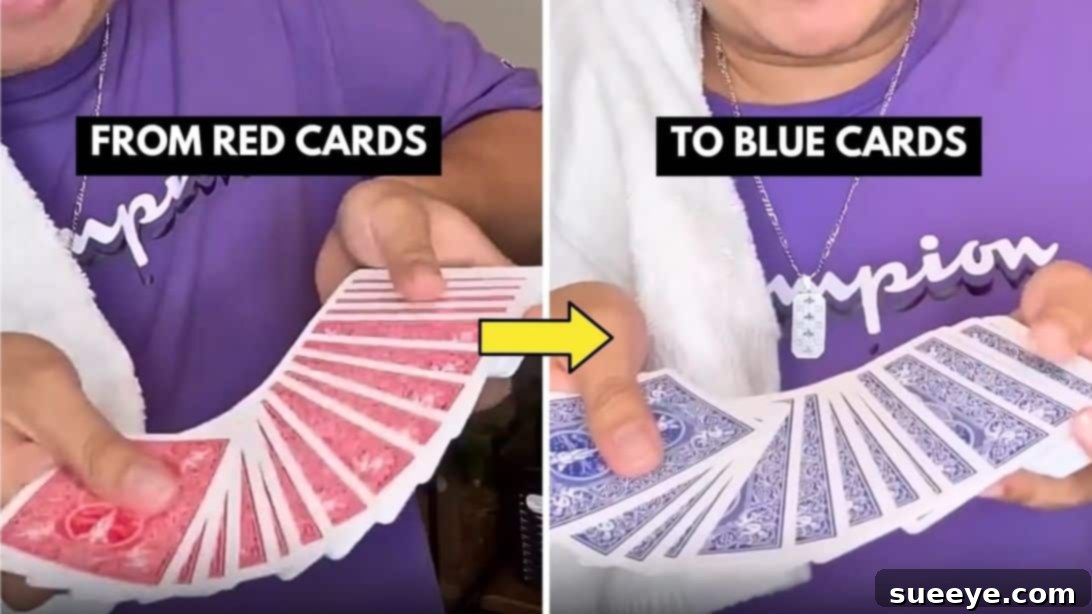
The card color change is a classic in magic, and this version offers a simple yet astonishing visual effect. It plays on the audience’s perception and a quick, decisive movement. The sudden transformation of a card’s color is a powerful illusion that often draws gasps of surprise, making you look like a seasoned card manipulator.
Materials Needed:
- Half a deck of blue-backed playing cards
- Half a deck of red-backed playing cards
- A small towel or handkerchief
Step-by-Step Instructions:
- Pre-Show Setup: Take approximately half of a blue-backed deck and half of a red-backed deck. Stack them face-to-face. This means the top card of one stack (e.g., blue) will be facing the bottom card of the other stack (e.g., red). You essentially have a small stack of cards where one half is blue-backed and the other is red-backed, joined in the middle. Place this combined stack discreetly in your pocket or somewhere easily accessible. You will also need a small towel or handkerchief; drape it casually over your shoulder, ready to be grabbed.
- The Reveal Setup: Approach your audience. Casually take out your prepared stack of cards. Hold the deck in one hand (e.g., your left hand), ensuring that only one color (say, blue) is visible to the audience. The other color (red) should be hidden underneath, ready for the flip. You might say, “Watch this blue deck very closely.”
- The Misdirection: With your free hand (your right hand, if you’re holding the cards with your left), reach for the towel on your shoulder. As you grab the end of the towel, your audience’s attention will naturally follow your hand. This is the perfect moment for your secret move.
- The Color Change: As you slide the towel over the cards, simultaneously and very quickly, use the hand holding the deck to smoothly rotate or flip the entire stack of cards over. This is done in one swift, fluid motion, ideally hidden by the towel as it passes. The towel acts as a visual shield, completely obscuring the brief moment of the flip.
- The Grand Reveal: Continue sliding the towel completely off the cards. As the towel is fully removed, the audience will see that the entire deck has miraculously changed color (e.g., from blue to red).
Tips for Performance:
- Speed and Smoothness: The success of this trick hinges on the speed and fluidity of the card flip. Practice until it’s one seamless motion.
- Towel Coverage: Ensure the towel fully covers the cards during the flip. A larger handkerchief might be easier for beginners.
- Patter: While grabbing the towel, engage your audience with a simple line like, “Sometimes a little magic needs a little covering…” or “Watch how quickly this happens!”
- Angle: Be mindful of your audience’s viewing angle. Perform directly in front of them to maximize the illusion.
3 – How to Make a Card Float: The Levitating Card
Making an object float is one of the most classic and visually stunning magical effects. This beginner-friendly method uses clever finger placement to create the illusion that a playing card is hovering in mid-air, defying gravity. It’s an excellent trick for developing finger dexterity and understanding how to use your hands to create convincing illusions.
Materials Needed:
- One standard playing card
Step-by-Step Instructions:
- The Secret Grip: Hold a playing card in front of you. Position your hands so that your two thumbs are gently pressing against the two shorter edges of the card. Your thumbs should be on the side of the card facing you, just barely gripping the edge. The key here is that only a small portion of your thumbs should be visible from the front if at all.
- Concealing the Thumbs: Now, bring your other fingers (index, middle, ring, pinky) of both hands forward. Position them in front of the card, slightly curved. The primary purpose of these fingers is to completely cover and conceal your thumbs, which are actually doing all the work of holding the card. From the audience’s perspective, it should look like your fingers are simply resting lightly against the card, not holding it firmly.
- The Illusion of Movement: Once your thumbs are concealed and your fingers are positioned, subtly and gently move the card using your thumbs. You can slightly push it up, down, or side to side. Because your thumbs are hidden by your other fingers, the card will appear to float freely, seemingly unsupported by anything. The tiny, controlled movements enhance the illusion of levitation.
Tips for Performance:
- Finger Positioning: Practice extensively in front of a mirror to ensure your thumbs are completely hidden from all typical viewing angles. The more natural your finger placement, the better the illusion.
- Subtle Movements: Don’t make large, jerky movements with the card. Small, gentle “wobbles” or slow ascents/descents will make the levitation more convincing.
- Eye Contact and Misdirection: Maintain eye contact with your audience or direct their gaze to the card. Avoid looking at your own thumbs.
- Storytelling: Introduce the trick with a bit of magical patter. “I’ve been working on my telekinetic powers…” or “Watch as this card defies gravity.”
The Art of Magic: Beyond the Tricks
Learning the mechanics of these easy magic tricks is just the beginning. To truly become an engaging performer, you need to understand the principles that elevate a simple stunt into a magical experience. These core concepts will help you not only execute these three tricks flawlessly but also prepare you for exploring more complex illusions in the future.
1. The Power of Misdirection
Misdirection is the cornerstone of almost every magic trick. It’s the art of directing the audience’s attention away from the secret move or action you’re performing. In the vanishing Q-tip trick, your patter and the act of closing your fist are designed to distract from your thumb’s secret hold. In the card color change, the towel is the perfect tool for misdirection. By consciously guiding your audience’s eyes and minds, you create a window of opportunity to execute your hidden actions without detection. Practice engaging your audience with your voice, your free hand, or even your eyes, while your working hand performs the actual secret.
2. Practice Makes Perfect (and Believable)
No magician, no matter how talented, performs a trick perfectly on the first try. Repetition is key. Practice each step of these illusions until it feels natural and effortless. Perform them in front of a mirror to catch any angles where your secret might be exposed. The goal is to make your movements so smooth and confident that they appear to be part of the magic itself, not a hidden technique. The more you practice, the less you’ll have to think about the mechanics, allowing you to focus on your presentation and connecting with your audience.
3. Presentation and Patter: Your Magical Story
A trick isn’t just about the sleight of hand; it’s about the story you tell. Develop a small “patter” – a narrative or dialogue – to accompany each trick. This could be a dramatic buildup, a humorous commentary, or an intriguing question. Your patter helps to set the mood, misdirect attention, and build anticipation. Coupled with confident body language, eye contact, and a touch of theatrical flair, a good presentation transforms a mere trick into an unforgettable moment of magic. Remember, you’re not just doing a trick; you’re creating an experience.
4. The Importance of Secrecy
A fundamental rule in magic is never to reveal your secrets. The wonder of magic lies in its mystery. Once a trick is explained, the enchantment often vanishes. By keeping the methods to yourself, you preserve the awe and inspiration that magic brings. This respect for the art maintains the integrity of magic and allows future generations to experience the same sense of wonder you did as a child.
Unleash Your Inner Magician
Learning these three easy magic tricks from SeanDoesMagic is more than just acquiring new skills; it’s about reigniting a sense of wonder, both for yourself and for those you entertain. From the surprising vanishing Q-tip to the captivating card color change and the mystifying floating card, these illusions provide a perfect entry point into the enchanting world of magic. They are simple enough for anyone to learn, yet powerful enough to leave a lasting impression.
So, gather your simple props, find your audience, and prepare to bring smiles and gasps of amazement. Remember, the true magic lies not just in the trick itself, but in the joy you create by sharing a moment of impossible wonder. Keep practicing, keep refining your presentation, and most importantly, keep the spirit of magic alive. Who knows? These beginner steps might just be the start of a lifelong passion for illusion. Happy dazzling!