
Emergency Lock Solutions: Clever Hacks to Open Padlocks Without a Key
We’ve all been there: the frustrating moment when you realize your keys are gone, broken, or simply forgotten. Whether you’re locked out of your home, unable to use your bike, or can’t access an important storage unit, a locked padlock can bring your day to a grinding halt. While prevention is always the best strategy, knowing a few emergency lock-opening techniques can be incredibly valuable in a pinch. This detailed guide, inspired by the ingenious methods showcased by Mr Wow on YouTube, will equip you with practical, albeit destructive, hacks to open various padlocks using common objects found in your home, toolbox, or garage.
These methods are designed for critical situations where traditional key access is impossible and professional locksmith services are not immediately available or feasible. Remember, these are last-resort techniques intended for personal property in genuine emergencies. They involve permanently damaging the lock, so always proceed with caution and a clear understanding of the implications.
Important Disclaimer & Safety Warnings
Before attempting any of these techniques, it is crucial to understand and adhere to the following safety guidelines and ethical considerations:
- Legality & Ethics: These methods are strictly intended for opening YOUR OWN locks in emergency situations. Attempting to open locks that do not belong to you or for illegal purposes is a criminal offense and can result in severe legal consequences. This guide is provided for informational purposes only.
- Personal Safety: Many of these hacks involve sharp objects, significant force, and potentially flying debris. Always wear appropriate personal protective equipment (PPE), including safety glasses and gloves, to prevent injury. Be mindful of your surroundings and ensure no one else is in harm’s way.
- Property Damage: The techniques described herein are inherently destructive. They will permanently damage the padlock, rendering it unusable. There is also a risk of damaging the item the lock is securing (e.g., a bike frame, a shed door). Proceed only if you are prepared to replace the lock and accept potential collateral damage.
- Tool Handling: Exercise extreme caution when using tools like craft knives, pliers, and wrenches. Improper handling can lead to slips, cuts, or crushed fingers.
- Last Resort: Consider these methods only after all other non-destructive options have been exhausted (e.g., finding a spare key, contacting a professional locksmith, seeking permission from the property owner).
Your safety and legal responsibility are paramount. Always prioritize a secure and lawful approach.
Essential Tools for Emergency Padlock Opening
The following tools are commonly found in most households or workshops and will be utilized across the different destructive padlock opening methods. Having them ready can significantly ease the process during an emergency:
- Sandpaper (Coarse Grit): Useful for abrading metal surfaces to expose internal mechanisms or weaken structural points.
- Craft Cutter Knife Blade (or similar sharp, thin blade): An extremely sharp and precise tool for scraping, cutting, or prying in tight spaces. A utility knife blade or a razor blade could also suffice.
- Longnose Pliers: Ideal for gripping small objects, holding blades securely, and providing leverage or twisting force.
- Flathead Screwdriver: Versatile for prying, twisting, or applying force to various parts of the lock. Choose one with a sturdy shaft.
- Gillette Blade (or similar razor blade): A thin, very sharp blade, often used in conjunction with pliers for cutting tasks.
- Wrenches (Two, adjustable or appropriate size): Crucial for generating leverage and applying significant breaking force to the padlock’s shackle. Two wrenches are needed for maximum effectiveness.
Step-by-Step Guide: Emergency Padlock Opening Techniques
Here are three distinct methods to open a padlock without its key, each employing a destructive approach suitable for different types of padlocks and scenarios.
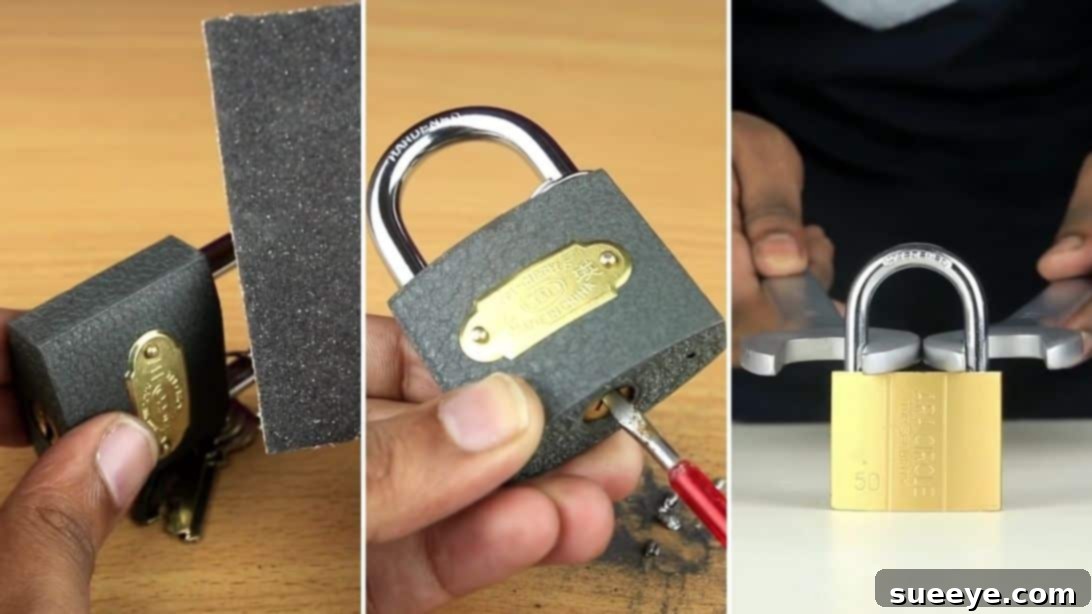
Method 1: Destructive Disassembly with Sandpaper & Blade
This technique targets the internal components of certain padlocks by physically dismantling the casing. It is particularly effective on padlocks with exposed, softer metal casings or less robust construction. The goal is to compromise the structural integrity of the lock body to access and release the shackle mechanism.
- Prepare the Padlock Surface: Take a piece of coarse-grit sandpaper and firmly rub it against the side of the padlock’s body. Focus on an area where the casing appears weakest or where you suspect the locking mechanism is housed. The aim here is to abrade the outer layer of metal, potentially exposing rivets, screws, or seams that hold the lock together. Continue rubbing until you observe a noticeable thinning of the metal or visible points of weakness.
- Expose and Remove Internal Fasteners: Once the metal casing is sufficiently worn down or thinned, carefully take your craft cutter knife blade (or another sturdy, sharp, thin tool). Use the sharp edge to scrape through the exposed metal. Your objective is to reach and scoop out any internal screws, pins, or fasteners that are now visible or just beneath the surface. These fasteners are crucial for holding the lock’s internal components in place. This step requires precision and patience, as you’re essentially deconstructing the lock’s casing.
- Loosen the Mechanism: As you successfully remove or loosen these internal fasteners, you’ll feel the lock’s body begin to weaken and its components shift. This action directly impacts the locking mechanism, making it less secure. The shackle, which normally holds the lock closed, will become easier to manipulate.
- Release the Shackle: With the internal mechanism compromised, grab a flathead screwdriver. Insert the tip into the keyhole and twist it firmly. The keyhole itself is often connected to the internal locking tumblers. With the other fasteners removed, twisting the keyhole with force should be enough to disengage the now-loose locking mechanism, causing the shackle or shank to spring open or become easily removable. This method effectively bypasses the conventional keying system by destroying the lock’s housing.
This method is generally best for cheaper, mass-produced padlocks where the casing offers less resistance. It’s a direct, destructive approach that leaves the lock irreparable.
Method 2: Shackle Cutting with Pliers & Blade
This hack focuses on physically cutting through the shackle—the U-shaped bar that secures the padlock. It’s an effective method for padlocks with shackles made of softer metals or thinner gauges, though it requires significant manual effort and careful handling of sharp tools.
- Prepare the Cutting Tool: Carefully take your longnose pliers. Select a sturdy razor blade, such as a Gillette blade, or a similar thin, sharp utility blade. Position the blade securely between the jaws of the longnose pliers, ensuring it is held very tightly. The pliers will act as a handle, allowing you to safely apply pressure and control the blade. Ensure only a small, sharp portion of the blade is exposed for cutting, minimizing the risk of accidental cuts.
- Position for Cutting: Identify the most accessible and thinnest point on the padlock’s shackle. This is typically the curved section or one of the straight sides, depending on how the lock is positioned. Place the exposed edge of the blade against this chosen point on the shackle.
- Begin the Sawing Motion: Hold the pliers firmly, maintaining a tight grip on the blade. Start a controlled back-and-forth sliding motion, similar to how you would use a saw. Apply consistent, firm pressure against the shackle with the blade. The goal is to slowly cut a groove into the metal.
- Continue Until Severed: Continue this sawing motion diligently. It will require considerable effort and patience, as you are manually cutting through metal. Periodically check your progress. As the blade wears down or becomes dull, you may need to reposition it or even use a fresh blade for optimal cutting efficiency. Keep sawing until the shackle is completely severed, allowing the lock to open.
This method is effective for various padlocks but is most practical for those with shackles that are not made of hardened steel, which would require much more advanced cutting tools. Always wear gloves and eye protection when performing this hack.
Method 3: Leverage Breakage with Wrenches
This technique employs brute force and the principle of leverage to physically break the padlock. It’s a quick and often effective method for many standard padlocks, as it exploits weaknesses in their construction when subjected to immense twisting force. This method almost guarantees the destruction of the lock.
- Gather Your Wrenches: You will need two wrenches. Adjustable wrenches are suitable, but fixed-size wrenches that fit snugly around the shackle can provide better grip and leverage. Ensure they are robust enough to withstand significant force without bending or breaking themselves.
- Position the Wrenches: Carefully insert one wrench into the arch of the padlock’s shackle, ensuring one jaw of the wrench grips one side of the shackle. Then, insert the second wrench into the other side of the shackle’s arch, so its jaw grips the opposite side. The goal is to have each wrench’s head firmly gripping one side of the shackle’s curve, allowing you to apply opposing forces.
- Apply Breaking Force: Once both wrenches are securely in place, grasp their handles firmly. Begin to pull the handles together towards the center of the padlock. This action will create a powerful twisting and spreading force on the shackle. The shackle is designed to resist outward pulling, but this technique focuses on twisting and bending its structure at a weak point.
- Break the Lock: Continue applying steady, increasing pressure, pulling the wrench handles closer and closer. You will typically hear a loud snap or crack as the shackle’s metal fatigues and breaks, or as the internal locking mechanism gives way under the immense stress. Once the handles meet in the middle or the padlock clearly separates, the lock will be broken and the item will be accessible.
This method is particularly effective against padlocks with weaker shackle materials or designs that are not reinforced against twisting forces. It’s a high-force technique, so maintain a stable stance and be prepared for the sudden release of tension when the lock breaks.
When to Use These Padlock Opening Methods (and When Not To)
These destructive techniques are best reserved for genuine emergencies. Consider them if you’ve:
- Lost the only key to a personal padlock, with no spare available.
- Broken a key inside the lock, rendering it unusable.
- Encountered a padlock that has rusted shut or seized due to extreme weather, making the key ineffective.
- Need urgent access to your property (e.g., a shed containing emergency supplies, your own bicycle) and a locksmith is hours away or financially unfeasible at that moment.
Conversely, NEVER use these methods if:
- The lock does not belong to you or you do not have express permission to open it.
- There is a non-destructive alternative available (e.g., a spare key hidden nearby, a trusted person with a key).
- The situation is not an emergency, and you can wait for professional assistance.
- The value of the lock or the potential damage to the secured item outweighs the urgency of access.
Preventative Measures: Avoiding Future Lockout Situations
While these hacks are useful in an emergency, the best approach is to avoid needing them in the first place. Here are some preventative tips:
- Spare Key Management: Always have at least one spare key, stored securely and accessibly (e.g., with a trusted neighbor, in a hidden key box, or digitally tracked).
- Key Trackers: Attach Bluetooth trackers to your keychains that can be located via a smartphone app.
- Regular Maintenance: Lubricate your padlocks periodically, especially those exposed to the elements, to prevent rust and sticking.
- Invest in Quality Locks: Higher quality, hardened steel padlocks are much more resistant to destructive entry methods, offering superior security.
- Alternative Locking Solutions: For some applications, consider combination locks (if you can easily remember or record the code) or smart locks that can be opened via an app.
Conclusion: Empowering You for Unexpected Lock Challenges
Dealing with a locked padlock when the key is nowhere to be found can be a significant source of stress. The methods detailed above, though destructive, offer practical solutions for those dire emergency situations. By understanding how to apply leverage, cut through metal, or dismantle a lock’s casing, you gain a unique ability to regain access to your property when all other options have failed. Remember the golden rules: prioritize safety, ensure legality, and view these techniques as a last resort. We extend our sincere gratitude to Mr Wow via YouTube for sharing these insightful and highly practical visual demonstrations that inspired this guide. If you found this tutorial helpful, be sure to visit their channel for more clever tips and tricks!