
Achieving a lush, green, and perfectly manicured lawn is a dream for many homeowners. However, this dream can quickly turn into a frustrating battle when invasive weeds like crabgrass decide to take root. Crabgrass is a notorious annual weed that can quickly overrun a healthy lawn, stealing essential nutrients and water from your desirable grass and leaving behind unsightly patches. Its rapid growth and prolific seed production make it a formidable opponent, often requiring significant time, effort, and resources to manage.
But fear not! Understanding the enemy and equipping yourself with the right knowledge and tools can turn the tide in your favor. This comprehensive guide will walk you through effective strategies to not only eliminate existing crabgrass but also implement robust prevention and control measures to ensure your lawn remains pristine year-round. We’ll delve into accurate weed identification, discuss various treatment options, and highlight crucial long-term lawn care practices that naturally suppress weed growth. For a visual demonstration and further insights, consider watching the detailed video by Pest and Lawn Ginja on Youtube, which provides valuable information on maintaining a beautiful, weed-free landscape.
The Battle Against Crabgrass: Understanding the Enemy and Achieving a Pristine Lawn
Why Crabgrass is a Menace to Your Lawn
Crabgrass (Digitaria spp.) is arguably one of the most common and persistent lawn weeds across temperate regions. It’s an annual weed, meaning it germinates from seed in the spring, grows vigorously through the summer, produces thousands of seeds, and then dies with the first hard frost in autumn. The problem isn’t just the visible weed; it’s the legacy of seeds it leaves behind, ensuring a fresh crop the following year. Crabgrass thrives in hot, dry conditions and thin, weak turf – precisely the conditions where your desirable lawn grasses struggle. It spreads rapidly, forming dense mats that choke out healthy grass, disrupt the uniform appearance of your lawn, and can make your entire yard look uncared for.
Step 1: Accurate Identification – The Foundation of Effective Weed Control
Before you can effectively combat any weed, you must first correctly identify it. Applying the wrong treatment can be wasteful, ineffective, and potentially harmful to your desirable lawn grasses or the environment. Many different types of grassy weeds can resemble crabgrass, but their control methods often differ significantly. Let’s learn to distinguish them.
Distinguishing Common Lawn Weeds from Crabgrass
- Tall Fescue (Festuca arundinacea): Often mistaken for a weed when it appears in desirable fine fescue or bluegrass lawns. Tall fescue typically grows in distinct, coarse bunches or clumps with thick, prominently veined leaves. Its texture is much coarser than common lawn grasses, and it tends to stand out as a taller, darker green patch. If you have tall fescue in your lawn where it’s not desired, chemical options are limited because it is a grass itself. Non-selective herbicides like Roundup (glyphosate) will kill everything it touches. For small infestations, manual removal is best.
- Johnson Grass (Sorghum halepense): A highly invasive perennial grass characterized by flat leaf blades and a distinct, light-colored midvein. It can grow quite tall and spreads aggressively via both seeds and rhizomes (underground stems). Due to its robust root system, it’s notoriously difficult to control. For early detection and smaller plants, pulling it out by hand before it establishes deep roots or produces seeds is the most effective method, though new shoots may emerge from rhizomes.
- Quackgrass (Elymus repens): Another perennial, highly rhizomatous grass that is incredibly difficult to eradicate. Quackgrass forms extensive networks of underground stems, allowing it to spread rapidly and resist many common control methods. Its leaves are often blue-green, and it can grow quite tall. Like Johnson grass, its perennial nature means it will survive winter and resprout each spring. Targeted non-selective herbicides applied precisely are usually needed for significant infestations, often requiring multiple applications.
If your lawn is infested with these perennial grasses rather than crabgrass, a non-selective herbicide like glyphosate (e.g., Roundup) is often the only chemical option, but it will kill all vegetation it contacts, including your desired turf. For these instances, a more targeted application method is recommended:
The “Sponging” Method for Perennial Grassy Weeds: This technique allows for precise application of non-selective herbicides, minimizing damage to surrounding desirable plants.
- Prepare the Solution: In a bucket, mix a small amount of glyphosate concentrate with water according to product instructions. Add a surfactant (a wetting agent that helps the herbicide stick to the leaves) if not already included in the product.
- Choose Your Tool: Use a cotton swab (Q-tip), a small sponge, or a paint roller for larger patches.
- Careful Application: Gently grab the specific weed blades you wish to eliminate. Carefully wipe or dab the herbicide solution onto the top two to three inches of the grass blade. The goal is to get enough herbicide on the plant for absorption without dripping or splashing onto your lawn.
- Warning: The most common mistake is applying too much solution, leading to drips that can kill surrounding grass. Precision is key.
Now, let’s talk about the real target:
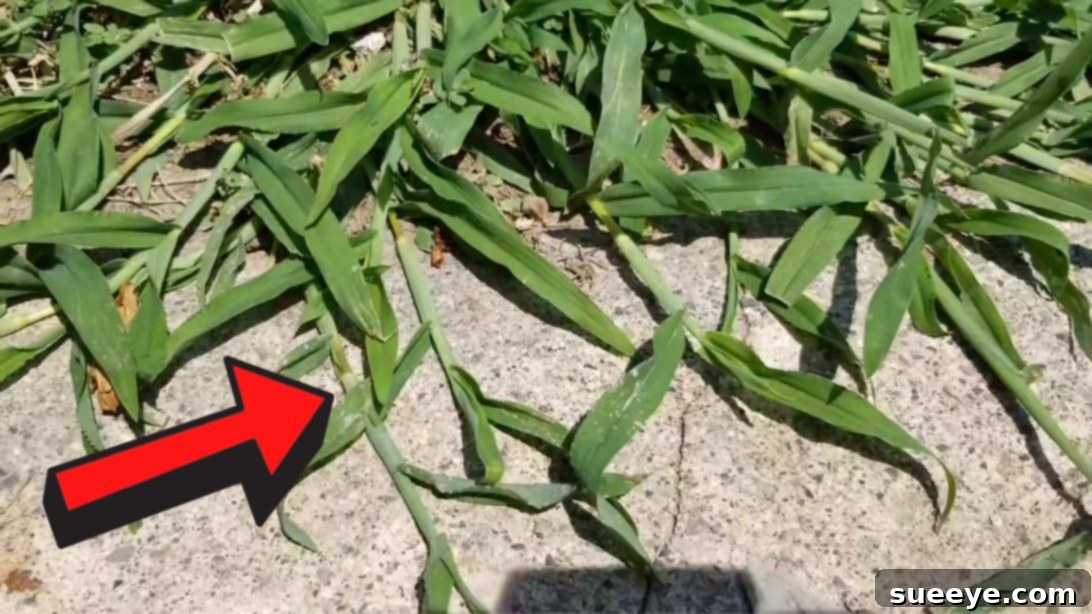
Crabgrass (Digitaria spp.): Distinctive features that set crabgrass apart include:
- Growth Habit: It’s a clumping grass that exhibits a sprawling, horizontal growth pattern, often parallel to the ground, radiating outwards from a central point.
- Leaf Blades: The leaves are typically broader than desirable lawn grasses and often have pointed tips. They can be light green to purplish at the base.
- Seed Heads: In late summer, crabgrass produces distinctive finger-like seed heads at the end of its stems, resembling a bird’s foot. These seed heads are crucial to its reproduction cycle.
- Annual Nature: Unlike the perennial weeds mentioned above, crabgrass is an annual. This means it germinates from seed each spring and dies completely in the fall, leaving behind a new generation of seeds.
Step 2: Strategic Elimination – How to Kill Existing Crabgrass
Once you are certain you have crabgrass, it’s time to take action. There are several effective methods to eliminate these weeds, ranging from chemical treatments to manual removal and even leveraging natural weather cycles.
Post-Emergent Herbicides: Your Chemical Weapon
Post-emergent herbicides are specifically designed to kill existing crabgrass plants after they have germinated and emerged from the soil. These products are most effective when applied to young, actively growing crabgrass. Key active ingredients to look for include Quinclorac, Fenoxaprop, and often blends that include 2,4-D or Dicamba for broader weed control.
- How They Work: These herbicides are absorbed by the crabgrass leaves and then translocated throughout the plant, disrupting its growth processes and ultimately leading to its demise.
- Application Tips:
- Apply when temperatures are moderate (typically between 60-85°F) and the crabgrass is actively growing. Avoid application during extreme heat or drought stress, as this can reduce effectiveness and potentially harm your lawn.
- Follow label instructions meticulously regarding mixing ratios, application rates, and safety precautions.
- After treatment, crabgrass will typically turn various colors (yellow, red, brown) before shriveling and dying. This process can take several days to a couple of weeks. This doesn’t mean it disappears instantly; you may still need to rake or manually remove the dead plants, especially larger ones, to clear your lawn.
- Some products may require a second application after a specific interval (e.g., 2-3 weeks) for complete control, especially with mature crabgrass.
Manual Removal: A Hands-On Approach
For smaller infestations or when you prefer a chemical-free approach, manual removal is an effective method. It’s particularly useful for young crabgrass plants that haven’t yet developed extensive root systems or produced seeds.
- Technique: Use a weeding fork, a trowel, or a specialized weed puller. It’s easiest to pull crabgrass when the soil is moist, as this allows for easier root extraction. Ensure you remove the entire plant, including the taproot, to prevent regrowth.
- Benefits: Immediate results and no chemical residues.
- Considerations: Time-consuming for large areas, and disturbed soil can bring new weed seeds to the surface.
The Role of Weather: Nature’s Way
Crabgrass, being an annual weed, is highly susceptible to cold temperatures. Once the ground temperature consistently reaches freezing (32°F or 0°C) or below, crabgrass plants will naturally die back. While this might provide temporary relief as winter approaches, it’s not a long-term solution because the plants will have already produced and dropped thousands of seeds, ensuring a fresh crop will emerge next spring. Relying solely on winter to solve your crabgrass problem is a recipe for annual disappointment.
Step 3: Proactive Prevention and Long-Term Control
The most effective strategy against crabgrass is prevention. A healthy, dense lawn is your best defense. By implementing proactive measures, you can create an environment that discourages crabgrass germination and growth, giving your desirable turf grass the competitive edge.
The Power of Pre-Emergent Herbicides
Pre-emergent herbicides are a cornerstone of crabgrass prevention. These products work by creating a chemical barrier in the top layer of the soil, inhibiting crabgrass seeds from germinating and emerging. They do not kill existing weeds; their purpose is purely preventive.
- Crucial Timing: The effectiveness of pre-emergents hinges entirely on precise application timing. They must be applied BEFORE crabgrass seeds begin to germinate. This usually occurs when soil temperatures consistently reach 50-55°F (10-13°C) for several consecutive days. A common natural indicator is when Forsythia bushes are in full bloom or when the dogwoods begin to flower in your area. Applying too early will cause the barrier to break down before germination begins, while applying too late means the crabgrass has already started to sprout.
- Types of Pre-Emergents: Popular active ingredients include Prodiamine, Dithiopyr, and Pendimethalin. Each has slightly different characteristics regarding application window and residual control.
- Application Process:
- Apply uniformly across your lawn using a spreader.
- Water in the pre-emergent after application (check product label, some require irrigation to activate the barrier, others are water-activated). This helps move the herbicide into the soil where it can form the protective barrier.
- Consider a “split application” – applying half the recommended rate early in the season and the remaining half a few weeks later. This can provide extended control, especially in areas with a long crabgrass germination window.
- Important Note for Overseeding: Be aware that pre-emergents can inhibit the germination of desirable grass seeds as well. If you plan to overseed your lawn in the spring, you should avoid applying pre-emergents, or choose products that explicitly state they are safe for newly seeded lawns (these often have a shorter residual effect). Overseeding is generally best done in the fall after the pre-emergent’s effectiveness has worn off.
Cultivating a Healthy, Resilient Lawn
Beyond chemical treatments, the most sustainable and effective way to control crabgrass long-term is to foster a dense, healthy lawn that naturally outcompetes weeds. Crabgrass thrives in weak, thin turf where sunlight can reach the soil and stimulate germination.
- Proper Mowing Height: This is a simple yet powerful tool. Set your mower blade to a higher setting, ideally between 3-4 inches. Taller grass shades the soil, keeping it cooler and blocking sunlight from reaching crabgrass seeds, thereby inhibiting germination. Mowing too short stresses your lawn and exposes the soil, creating ideal conditions for crabgrass.
- Strategic Watering: Water your lawn deeply and infrequently. Instead of light, daily sprinkles, aim for about 1 inch of water per week, applied in one or two sessions. Deep watering encourages your desirable grass to develop deep, robust root systems, making it more drought-tolerant and competitive. Shallow watering, on the other hand, keeps the topsoil consistently moist, which promotes shallow-rooted weeds like crabgrass.
- Effective Fertilization: A well-fed lawn is a strong lawn. Fertilize your lawn according to soil test recommendations, typically in spring and fall (depending on grass type). This provides essential nutrients for strong growth, allowing your turf to become dense and healthy, crowding out weeds. Avoid over-fertilizing, especially in summer, as this can encourage crabgrass growth in some cases.
- Aeration and Dethatching: Over time, soil can become compacted, and a layer of thatch (dead grass material) can build up, hindering water and nutrient penetration. Aerating (poking holes in the soil) and dethatching (removing excess thatch) improve air circulation, water absorption, and nutrient uptake, leading to a healthier lawn that is more resistant to weeds. These are best done in the fall.
- Overseeding: If your lawn has bare spots or is thinning, overseeding in the fall is an excellent strategy. Introducing new grass seeds helps to fill in these gaps, creating a denser turf that leaves no room for crabgrass or other weeds to establish themselves the following spring.
Integrating Strategies for a Crabgrass-Free Future
Achieving and maintaining a crabgrass-free lawn requires an integrated approach. It’s not just about one-time fixes but rather a continuous cycle of good lawn care practices combined with targeted treatments when necessary. Start with accurate identification, employ post-emergent herbicides or manual removal for existing weeds, and critically, implement a robust prevention program with timely pre-emergent applications and consistent cultural practices.
Remember that patience and consistency are key. Transforming a crabgrass-ridden lawn into a pristine green carpet doesn’t happen overnight, but with dedication to these strategies, you can significantly reduce and eventually eliminate crabgrass, allowing your desirable lawn grasses to thrive.
Conclusion: Your Path to a Perfect Lawn
Dealing with crabgrass can certainly be a frustrating endeavor, but with the knowledge and tools outlined in this guide, you are well-equipped to win the battle. From correctly identifying the culprit to applying precise treatments and implementing year-round preventative measures, every step contributes to a healthier, more beautiful lawn.
By committing to proper lawn care practices – including strategic mowing, watering, fertilizing, and timely pre-emergent applications – you can significantly reduce the presence of crabgrass and create a vibrant, resilient turf that will be the envy of your neighborhood. Embrace these strategies, stay vigilant, and enjoy the satisfaction of a truly perfect, crabgrass-free lawn.