
How to Easily Tell if Eggs Are Fresh: The Ultimate Guide to Perfect Eggs Every Time
Ensuring the freshness of your eggs is far more than just a culinary preference; it profoundly impacts the success of your dishes, their taste, and crucially, your food safety. Have you ever attempted to poach an egg, only for it to spread into an unappetizing cloud in the simmering water? Or perhaps you’ve baked a delicate cake that didn’t rise quite right, or scrambled eggs that lacked their usual creamy texture? The culprit behind such kitchen frustrations is often an egg that is past its prime. The age of an egg directly influences its internal structure, its ability to hold shape, and its overall performance in the kitchen. Learning how to accurately assess an egg’s freshness is an invaluable skill for any home cook, saving you time, wasted ingredients, and potential disappointment. This comprehensive guide will equip you with simple, effective methods to determine egg freshness, ensuring you always select the best eggs for every recipe. We’ll explore practical techniques for both unbroken and cracked eggs, drawing inspiration from expert insights to transform you into an egg freshness pro.
Why Egg Freshness Matters: Beyond Just the Date on the Carton
Before diving into the “how-to” of identifying fresh eggs, let’s understand the compelling “why.” An egg’s freshness isn’t merely about avoiding spoilage; it’s about optimizing your cooking results. Fresh eggs possess firm, plump yolks, thick, viscous whites, and minimal internal air cells. These characteristics make them ideally suited for dishes where structure, texture, and visual appeal are paramount. For instance, achieving a perfectly formed poached egg necessitates a very fresh egg; its robust white will cohere beautifully in hot water, gracefully encasing the yolk without fragmenting. Similarly, when frying, a fresh egg yields a compact, well-defined white that doesn’t spread excessively, alongside a proudly plump, spherical yolk.
As an egg ages, its internal structure gradually breaks down. The yolk membrane weakens, causing the yolk to flatten and spread more easily. Simultaneously, the thick albumen (egg white) begins to thin and become more watery. This natural degradation impacts not only the aesthetic appeal of the egg but also its functional properties. For example, older eggs might struggle to provide the necessary binding or leavening capacity in baking, or they might be difficult to separate cleanly if a recipe calls for yolks and whites individually. While some dishes, such as hard-boiled eggs, can actually benefit from eggs that are a few days older (as they are typically easier to peel), knowing the precise state of your eggs allows you to make informed decisions for every recipe, preventing culinary mishaps and elevating your cooking.
Method 1: The Water Test – The Simple Float Test for Unbroken Eggs
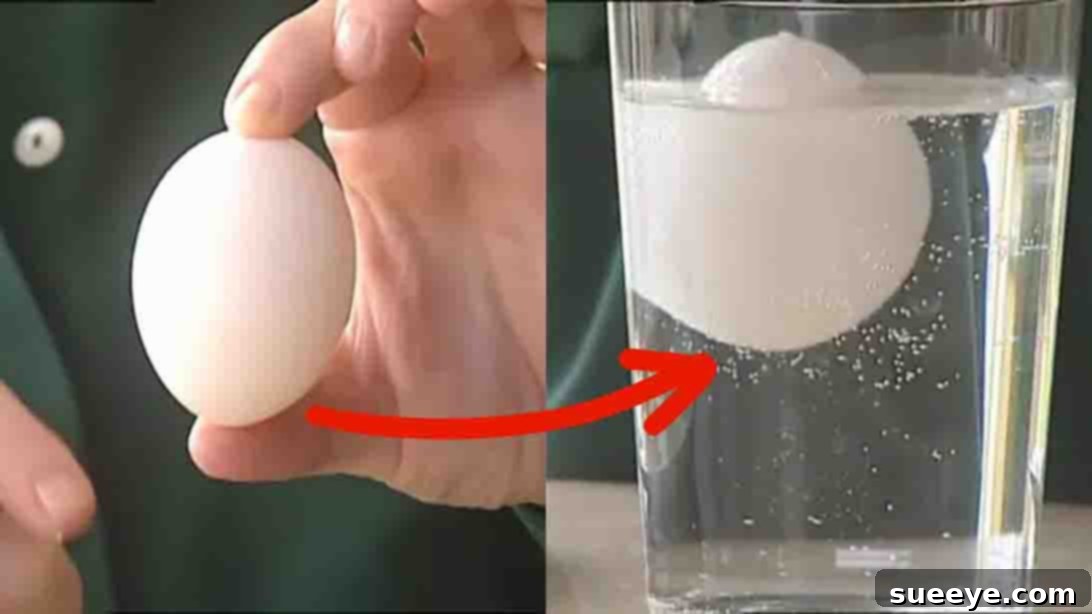
The simplest and most widely recognized method for assessing egg freshness without cracking the shell is the classic water test, commonly known as the float test. This ingenious technique leverages a natural physiological change that occurs within an egg as it ages: the gradual enlargement of its air cell. Eggshells are remarkably porous, allowing moisture to slowly evaporate through them over time. As this moisture dissipates, the air cell – located at the blunt end of the egg – expands to fill the void. The larger this air cell becomes, the more buoyant the egg will be in water. This fascinating and entirely natural process provides a remarkably reliable visual indicator of an egg’s age.
Step 1: Setting Up Your Egg Freshness Test
To perform this straightforward test, you’ll need a tall glass or a deep bowl, and enough cold tap water to fully submerge an egg. Carefully place the egg into the water, being sure to lower it gently rather than dropping it from a height, as this could cause it to crack. Once submerged, observe its behavior closely. The way the egg reacts to the water immediately provides clear clues about its age and overall condition, allowing you to quickly sort your eggs into categories of freshness.
Step 2: Interpreting the Results of Your Egg Float Test
The position an egg takes in the water is a direct reflection of the size of its internal air cell and thus, its freshness:
- Sinks Horizontally to the Bottom (Very Fresh): If your egg immediately sinks to the bottom of the glass and lies completely flat on its side, you’ve got a winner! This indicates an exceptionally small air cell, meaning very little moisture has evaporated since the egg was laid. These eggs are at their peak freshness and are absolutely perfect for delicate culinary applications such as poaching, frying, or any dish where a firm structure and vibrant flavor are desired.
- Sinks and Tilts Up Slightly (Still Fresh, but a Few Days Old): An egg that sinks to the bottom but stands upright on its blunt end, or tilts slightly into a semi-vertical position, is still perfectly good to eat. Its air cell has expanded a bit more, but it is far from being considered stale or compromised. These eggs are excellent for the vast majority of cooking applications, including scrambling, making omelets, or baking. They are also often the ideal choice for hard-boiling, as their slightly larger air cell makes them considerably easier to peel than super-fresh eggs.
- Floats Vertically at the Top (Older, Use with Caution): If the egg floats entirely to the surface of the water, standing upright, it’s a clear sign of an older egg. The significantly larger air cell indicates that a considerable amount of moisture has been lost through the shell. While a floating egg isn’t automatically spoiled, it is definitely past its prime for dishes that rely on its structural integrity, like poaching or frying. It’s best reserved for recipes where its age won’t detract significantly, such as hard-boiling, baking into casseroles, or making scrambled eggs. However, it is absolutely essential to perform a thorough smell test upon cracking any egg that floats to ensure it hasn’t truly gone bad.
- Floats Entirely and Lies Flat on the Surface (Likely Spoiled – Discard Immediately): If an egg floats completely on the surface, lying flat or barely breaking the water’s surface, it is highly likely to be spoiled. The significant gas buildup inside, a byproduct of decomposition, causes it to be fully buoyant. In this scenario, it is strongly advised to discard the egg without cracking it, as the unpleasant, sulfurous smell will be unmistakable and potent.
Method 2: Visual Inspection – What Cracked Eggs Reveal About Their Age
While the water test is an excellent first step for unopened eggs, sometimes you’ve already cracked an egg, or you simply prefer a direct visual assessment. The appearance of a cracked egg, particularly its yolk and whites, provides another highly reliable set of indicators for its freshness. The internal structure of an egg undergoes noticeable and predictable changes with age, offering clear visual cues that any observant home cook can easily recognize and interpret.
Step 1: Observing the Yolk and Albumen of a Truly Fresh Egg
Carefully crack an egg onto a clean, flat plate or into a shallow, clear bowl. A truly fresh egg will display several very specific and desirable characteristics:
- Plump, Round, and High Yolk: The yolk will be notably high, firm, and perfectly round, sitting proudly in the center of the white. Its membrane will appear strong and taut, making it quite resistant to breaking even with gentle handling.
- Distinct Double Ring of Thick White: You will clearly observe two distinct layers of egg white, also known as the albumen. The innermost layer, which immediately surrounds the yolk, will be remarkably thick, viscous, and gelatinous, holding its shape tightly and not spreading much. This is often referred to as the “thick white.” Beyond this, there will be a thinner, more watery outer layer. The clear separation, firmness, and minimal spread of the thick white are key indicators of peak freshness.
Step 2: Identifying an Egg That’s Not-So-Fresh (But Still Good)
As an egg ages slightly, its internal structure begins a natural breakdown process, though it remains perfectly safe and usable for many culinary applications:
- Slightly Flatter, Wider Yolk: The yolk will still be predominantly round but may appear noticeably flatter and less plump than that of a very fresh egg. Its membrane might be a little weaker, making it more prone to breaking if handled without care.
- Less Visible Double Ring, Thinner, Spreading White: The distinction between the thick and thin whites becomes less pronounced. The thick white will start to spread more easily and broadly across the plate, and the overall white will appear more watery and less cohesive, lacking the firm jelly-like consistency of a fresh egg.
Step 3: Recognizing a Stale or Borderline Egg
For eggs that are significantly older or potentially stale, the visual changes become even more apparent and should serve as a warning sign:
- Very Flat, Spreading Yolk: The yolk will be noticeably flat and will likely spread out significantly, often struggling to maintain any semblance of a round shape. It will also be extremely prone to breaking with minimal disturbance.
- Completely Watery White, No Distinct Layers: The entire egg white will be uniformly thin, watery, and spread out widely across the plate, completely lacking any discernible thick or thin layers. It will not hold its shape at all, resembling a puddle more than a structured white.
Crucial Note: The Indispensable Smell Test. Regardless of any visual cues, if a cracked egg emits a strong, profoundly unpleasant, sulfur-like odor (often described as a “rotten egg” smell), it is unequivocally spoiled and must be discarded immediately. This distinctive odor is a definitive indicator of bacterial growth and is a far more reliable sign of true spoilage than any visual characteristic alone for eggs that have gone truly bad. Trust your nose above all else in these instances.
Beyond Visuals: Other Helpful Tips for Assessing Egg Freshness
While the water test and visual inspection of cracked eggs are highly effective and widely trusted, here are a few additional tips and considerations to keep in mind for a comprehensive assessment of egg freshness:
- Check the Date on the Carton: Always refer to the “best by,” “sell by,” or “expiration” date printed on the egg carton. While this date is not an absolute indicator of spoilage (eggs can often remain good past this date, especially if stored correctly), it serves as a helpful initial guide for estimating their age and planning their use.
- The Gentle Shake Test: Hold an egg gently near your ear and give it a slight shake. If you hear or feel the contents sloshing or moving around significantly inside the shell, it indicates a very thin egg white and a loose yolk, both signs of an older egg. A very fresh egg will have virtually no discernible sound or movement when shaken, as its contents are firm and tightly contained.
Optimizing Egg Storage for Maximum Freshness and Longevity
Even with excellent testing methods at your disposal, proper storage is absolutely paramount to extending the life and preserving the freshness of your eggs. By following these best practices, you can ensure your eggs remain at their best for as long as possible, reducing waste and maximizing their culinary potential:
- Refrigerate Immediately and Consistently: Eggs should be stored in the coldest part of your refrigerator, ideally on an inner shelf, rather than in the door. The refrigerator door is subject to frequent opening and closing, leading to significant temperature fluctuations that can degrade egg quality more quickly.
- Keep Them in Their Original Carton: The egg carton serves a crucial dual purpose. Firstly, it provides excellent protection against absorbing odors and flavors from other foods in your fridge, as eggshells are porous. Secondly, it helps to prevent moisture loss, which slows down the air cell expansion process.
- Store with the Pointy End Down: This seemingly minor detail can make a difference. Storing eggs with the pointy end facing down helps to keep the yolk centered within the egg and prevents the air cell at the blunt end from expanding too rapidly, thus maintaining freshness longer.
- Avoid Washing Eggs at Home: In many countries (including the United States), commercially processed eggs are washed and then coated with a thin layer of food-grade mineral oil. This coating seals the pores of the shell, protecting against bacterial contamination. Washing eggs at home can inadvertently remove this natural or applied protective layer, making them more susceptible to bacteria entering through the shell.
Making Informed Choices for Your Culinary Creations
Understanding and applying these simple egg freshness tests is a fundamental skill that empowers you to make better, more confident choices in the kitchen. Whether you’re aiming for a perfectly set quiche, a cloud-like meringue, a flawlessly fried egg, or simply a delicious scramble, the quality and freshness of your eggs play a pivotal role in the final outcome. By regularly applying the straightforward water test and paying close attention to the visual cues once an egg is cracked, you can confidently determine its age and suitability for your intended recipe.
Remember, while a slightly older egg might not be ideal for every delicate dish, it is often perfectly fine, and even preferable, for others. This knowledge not only enhances your cooking results but also helps in reducing food waste, making you a more resourceful and efficient cook. So, the next time you reach for an egg, take a moment to assess its freshness – your taste buds, and your cooking, will undoubtedly thank you for it!
For more fantastic culinary tips, tutorials, and inspiration, consider exploring reputable resources like BBC Good Food’s YouTube channel, which consistently shares valuable insights for home cooks of all skill levels.