
Have you ever paused to truly observe the tools you interact with daily? Beyond their obvious functions, many common household and workshop items are ingeniously designed with subtle indentations, unusual curves, or seemingly insignificant holes. Most of us tend to overlook these details, often assuming they are mere aesthetic touches or perhaps quirks of the manufacturing process. However, what if these often-ignored elements hold a deeper, more brilliant purpose, meticulously engineered to enhance functionality and simplify your tasks in ways you’ve never imagined?
The world around us is brimming with such clever secrets, embedded in the very objects we take for granted. This delightful phenomenon is perfectly exemplified by the little red ball found on a seam ripper. For countless years, many dedicated crafters, including myself, utilized this indispensable sewing tool without ever questioning the true intent behind that distinctive red sphere. It wasn’t until a fascinating online discovery that its brilliant purpose came to light – a revelation that completely transforms the approach to fabric work and makes the task of unpicking stitches far more efficient. If you’re eager to uncover the full story behind this specific ingenious detail, you can dive deeper into its secrets here: The Secret of the Red Ball on Your Seam Ripper.
This experience serves as a powerful reminder of how much utility and clever design we might be missing in the tools that are literally at our fingertips. From kitchen gadgets that multitask effortlessly to workshop essentials with concealed efficiencies, numerous items in your home boast ingenious hidden features. These can make daily chores easier, safer, and remarkably more efficient, standing as a testament to thoughtful engineering where designers embed brilliant solutions directly into the form and function of the object itself.
RELATED: Uncover the Hidden Messages and Clever Designs in Famous Logos You See Every Day!
Are you ready to unlock the full, often untapped, potential of your toolkit? Join us on an exciting journey as we explore a fascinating list, originally compiled and highlighted by The Maker, revealing the ingenious, yet frequently overlooked, capabilities of common household and workshop tools. Prepare to have your perspective broadened and your daily tasks made considerably simpler through the power of smart design.
And if these revelations prove helpful and inspire you to look at your tools with fresh eyes, be sure to explore another comprehensive guide that delves deeper into this fascinating topic: Hidden Features of Tools You Use Every Day.
Unlocking the Full Potential: Hidden Features of Tools You Never Knew Existed
It’s truly remarkable how much utility can be meticulously packed into a seemingly simple design, often going completely unnoticed by the casual user. This oversight means many of us are missing out on incredible efficiencies and ingenious solutions. Let’s delve into some prime examples of tools that offer far more than meets the eye, transforming everyday challenges into simple, manageable tasks with their clever, concealed functionalities.
1 – The Versatile Bar Clamp: Your Unexpected Lifting Assistant
Bar clamps are an indispensable staple in virtually any workshop, celebrated for their robust ability to securely hold workpieces together during critical processes like gluing, cutting, or assembly. However, their utility, particularly in larger sizes, extends dramatically beyond mere clamping. Imagine the considerable struggle involved in single-handedly maneuvering large, unwieldy sheets of plywood, hefty drywall panels, or heavy timber boards. These materials are not only cumbersome and difficult to grip but can also pose a significant risk of injury to your back and shoulders if not handled with extreme care and proper technique. This is precisely where a bar clamp reveals one of its most ingenious, yet often astonishingly underutilized, hidden features.
Instead of wrestling with a heavy sheet, desperately trying to maintain an awkward, hand-straining grip that puts undue stress on your body, there’s a much simpler solution. Simply attach a bar clamp firmly to one edge of the sheet. By securing the clamp, you instantly create a robust, comfortable, and ergonomic handle. This allows you to lift and carry large sheets with surprising ease, significantly improved control, and enhanced stability. This technique dramatically improves your grip, distributes the weight more effectively, and most importantly, enables you to manage substantial materials with just one hand, freeing your other hand for additional stability, guiding, or even opening doors. It’s a simple yet revolutionary trick that transforms what would typically be a challenging, often two-person job into a remarkably manageable solo operation, thereby enhancing both safety and efficiency in all your woodworking, construction, or DIY projects. This clever hack not only saves your back but also speeds up your workflow considerably.
2 – Kitchen Scissors: A Multi-Functional Marvel Beyond Basic Cutting
Kitchen scissors are undoubtedly a workhorse in any culinary space, proving invaluable for a vast array of tasks, from effortlessly opening stubborn packages and snipping fresh herbs to precisely cutting poultry. But have you ever taken a moment to examine their design up close? Many modern kitchen scissor models feature intriguing, often overlooked, elements such as curved metal nubs positioned between the handles or a distinct U-shaped indentation near the pivot point of the blades. These aren’t merely decorative flourishes or accidental byproducts of manufacturing; they are prime examples of brilliant integrated multi-functionality, meticulously designed to tackle common kitchen dilemmas with surprising ease and efficiency.
Those prominent, curved metal nubs located strategically between the handles are ingeniously designed to act as a powerful, integrated nutcracker. Their robust construction and the substantial leverage provided by the scissor handles allow you to effortlessly crack open various types of nuts – from walnuts to pecans – saving you the hassle of searching for a dedicated nutcracker or resorting to less safe, improvised methods. Furthermore, this very same feature proves incredibly useful for gaining purchase on and ultimately opening stubborn jar lids. The nubs provide an excellent, non-slip grip on tight lids, enabling you to apply ample force without your hand slipping, making quick work of even the most resistant vacuum seals.
Adding another layer to their remarkable versatility, many kitchen scissors also incorporate a distinct U-shaped cutout or notch on the side of one of the blades, typically near the pivot. This often-overlooked indentation serves a singular, convenient purpose: it functions as a built-in bottle opener. No more fumbling through crowded drawers or scrambling for a separate opener when you need to pop the top off a refreshing beverage. These cleverly integrated features transform your humble kitchen scissors from a simple cutting tool into an all-in-one culinary utility, embodying a philosophy of clever design that maximizes efficiency, reduces the need for multiple single-purpose gadgets, and minimizes clutter in your precious kitchen drawers.
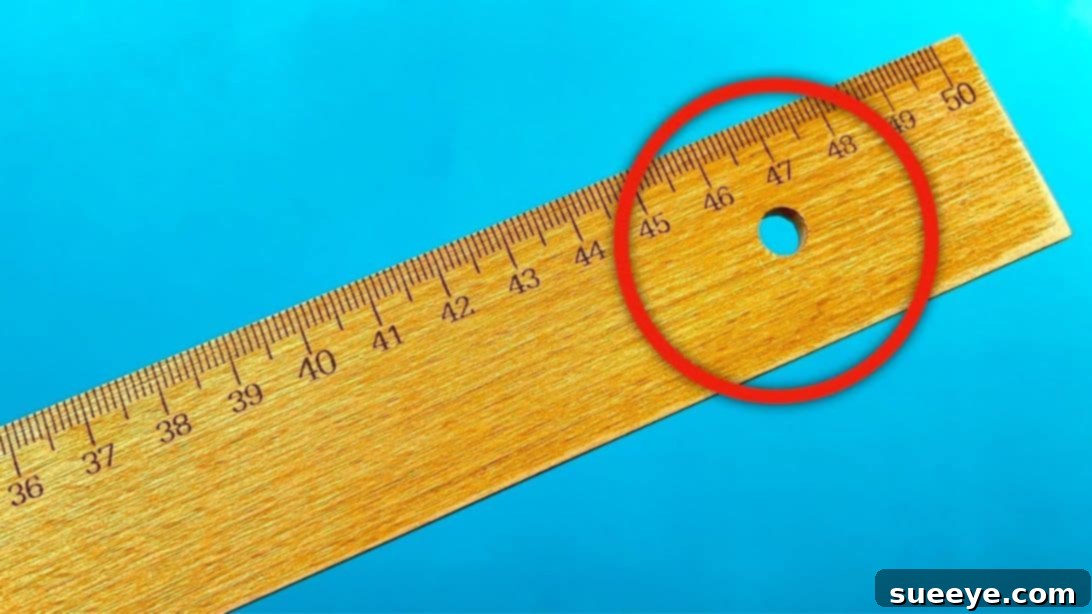
3 – The Humble Wooden Ruler with a Surprising Circle-Drawing Hole
On the surface, a wooden ruler appears to be one of the most straightforward and self-explanatory tools imaginable: a simple straight edge designed for precise measurement and drawing perfectly straight lines. However, many traditional wooden rulers, especially those crafted for carpentry or drafting, come subtly equipped with a small, circular hole meticulously drilled near one of their ends. While its most obvious and frequently utilized purpose might indeed be for conveniently hanging the ruler neatly on a hook in your workshop or classroom, its true genius and hidden potential lie in its remarkable capacity to transform the ruler into a surprisingly versatile and accessible drawing instrument.
This seemingly simple hole is actually a key to unlocking the ability to draw precision curves and perfect circles without the need for a separate compass. To effectively utilize this clever feature, you can simply insert the tip of a pencil, a pen, or even a small nail through the hole. By firmly holding the ruler steady at a fixed pivot point with one hand and guiding the pencil, through the hole, with the other, you can smoothly pivot the ruler around that central point. This technique allows you to effortlessly draw beautifully consistent arcs, graceful curves, or even complete, perfectly round circles on various surfaces, whether it’s wood, paper, fabric, or even a whiteboard. For marking precise straight lines, the hole can also serve as an excellent starting or ending point marker, ensuring perfect alignment and consistency. This hidden function dramatically enhances the ruler’s utility far beyond basic linear measurement, making it an invaluable aid for students, artists, architects, carpenters, and craft enthusiasts who require precise radii or smooth, symmetrical curves in their projects, all conveniently available without needing to reach for an additional specialized tool.
4 – Zip Ties: Reusability Unlocked – The Secret to Releasing Without Cutting
Zip ties, universally recognized and also commonly known as cable ties, are ubiquitous fasteners lauded for their incredible versatility in bundling cables, securing items, or creating robust temporary fixes in countless scenarios. Their primary appeal lies in their strong, one-way locking mechanism, which typically implies that once they are fastened and tightened, the only conventional way to remove them is by cutting them. This often leads to unnecessary waste, particularly when a zip tie is used for a temporary application, needs a slight adjustment, or if you simply wish to reuse it. However, there’s a lesser-known, ingenious trick that allows you to release and effectively reuse zip ties, making them far more versatile, economical, and environmentally friendly than their single-use reputation suggests.
The secret to this reusability lies hidden within the square locking head of the zip tie itself. Inside this compact housing, there’s a tiny, crucial component known as a “pawl” or “tongue” – a small, angled strip of plastic meticulously designed to catch on the serrated teeth of the tie, effectively preventing it from backing out once tightened. To release the zip tie without resorting to cutting, simply locate this small, often recessed pawl. Using a slender needle, the tip of a small screwdriver, the end of a paperclip, or any other thin, pointed object, gently yet firmly push the pawl upwards or away from the tie’s teeth. As you apply slight pressure, you will feel it disengage with a subtle click. While holding the pawl in its disengaged position, you can then easily pull the free end of the zip tie back through the locking mechanism, releasing it entirely. This remarkably simple yet effective method allows you to reuse zip ties multiple times, significantly saving money, reducing plastic waste, and demonstrating that even the simplest, most disposable-seeming tools can harbor unexpected design intelligence and hidden potential for sustainability.
5 – Silicone (Sealant) Tubes: Smart Storage and Preservation in the Nozzle Design
Working with silicone caulk, various sealants, or adhesive tubes can often be a messy endeavor, and properly storing an opened tube to prevent its contents from prematurely drying out or hardening is a remarkably common and frustrating challenge for DIY enthusiasts and professionals alike. All too often, people resort to makeshift caps, wrapping tape, or struggling to clear a hardened nozzle for future use, leading to wasted product and unnecessary effort. However, many modern sealant tubes are designed with an incredibly practical, yet frequently overlooked, feature right on the nozzle itself, aimed at tackling this very problem.
At the very bottom, or sometimes molded into the base of the removable nozzle, you’ll often discover a small, perfectly circular indentation or ring. This isn’t merely a byproduct of the manufacturing injection molding process; it is a very clever and intentional design element with ingenious dual purposes. Firstly, this circle often allows for incredibly convenient storage of the nozzle itself when it’s not actively in use. After completing your sealing task and cleaning the nozzle, you can often remove it from the main sealant tube and use this circular base to securely hang it on a small nail, screw, or hook, keeping it clean, clear, and readily accessible for your next project. More importantly, and perhaps more innovatively, some sealant tubes are precisely engineered so that this circular base of the nozzle fits snugly and perfectly onto the tip of the main sealant tube after the nozzle has been removed. When applied correctly, it effectively creates an airtight or near-airtight seal, which dramatically helps to preserve the remaining caulk or sealant and crucially prevents it from hardening within the tube’s opening or within the nozzle itself. This simple, elegant feature directly addresses a common user frustration, significantly extending the usable life of your sealant products, minimizing product waste, and ensuring that your next sealing project can begin much smoother and without the hassle of a blocked or hardened nozzle.
Beyond the Obvious: Embracing the Ingenuity in Everyday Design
Our journey through these hidden features of everyday tools is far more than just learning a handful of new tricks; it’s an inspiring awakening to the incredible foresight, meticulous planning, and profound problem-solving embedded within the very design of even the most mundane objects we interact with daily. From effortlessly making heavy lifting easier with the unexpected utility of a bar clamp, to transforming simple kitchen scissors into a multi-tool marvel, and from breathing new life and reusability into single-use zip ties to smartly preserving your silicone sealant with a clever nozzle design, these discoveries highlight the thoughtful engineering and user-centric design that often goes completely unappreciated.
These secret functions aren’t merely accidental quirks or coincidences; they are deliberate manifestations of designers’ tireless efforts to anticipate user needs, enhance efficiency, promote safety, and, in many cases, even reduce waste and improve sustainability. By becoming more observant, more curious, and more engaged with the tools and objects we interact with daily, we can unlock their full, incredible potential. This transforms common, often tedious tasks into simpler, more enjoyable, and significantly more efficient experiences. So, the next time you pick up any tool, take a moment to examine it closely, feel its contours, and ponder its various components. You might just discover another ingenious feature patiently waiting to be unveiled, a small revelation that could revolutionize the way you work, play, and interact with the fascinating world of design all around you. What other hidden features have you stumbled upon in your own home or workshop? We encourage you to share your unique discoveries and let’s continue to celebrate the boundless cleverness of everyday design!