
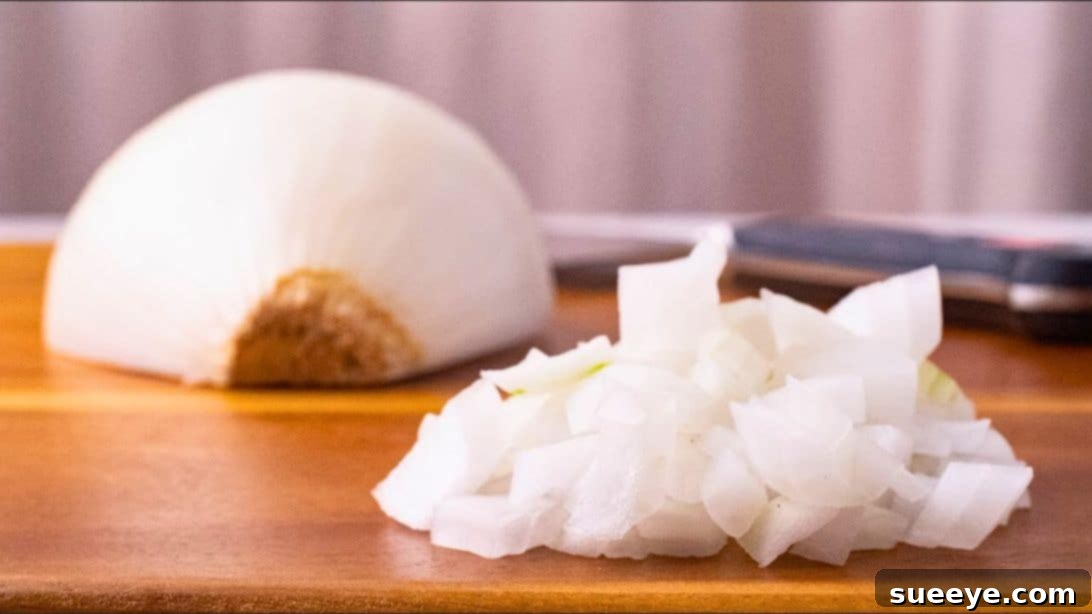
Master the Art: How to Cut Onions Without Crying – Your Ultimate Guide to Tear-Free Chopping
Onions are undeniably one of the most foundational ingredients in global cuisine, right alongside garlic. They are the unsung heroes that elevate countless dishes, infusing them with rich flavors, aromatic depth, and a delightful complexity. From French onion soup to a simple stir-fry, the humble onion forms the aromatic base for almost every savory creation, making it an absolute must-have in any kitchen.
However, the joy of cooking with onions often comes with an inevitable challenge: the dreaded tears. Anyone who has spent time dicing onions knows the burning sensation and the stream of tears that can quickly turn a pleasant cooking task into a teary-eyed ordeal. This common culinary conundrum can deter even seasoned cooks from preparing dishes that call for a generous amount of this flavorful bulb.
The inspiration for finding a foolproof method to combat onion tears struck during a memorable family gathering last December. My cousin, tasked with preparing a dish that required a substantial quantity of onions, began chopping away. Within minutes, the entire kitchen was filled with potent onion fumes, and everyone present, despite the room being well-ventilated, found their eyes irritated and watering profusely. It was a clear reminder that the struggle against onion tears is real and widespread.
Determined to find a solution, I embarked on a quest for the best way to cut onions without crying. My research led me to a fantastic tip shared by Camy Arriol on YouTube. Intrigued, we immediately put her technique to the test, and to our amazement, it worked wonders! The kitchen remained tear-free, and the onions were prepped with ease. This transformative experience compelled me to share this invaluable method, ensuring that no one has to suffer through onion tears again.
If you’re tired of watery eyes and sniffles every time you chop an onion, you’ve come to the right place. This comprehensive guide will walk you through a proven technique that minimizes the release of tear-inducing compounds, allowing you to slice and dice with confidence. We’ll also explore the science behind onion tears and share additional practical tips to enhance your onion-cutting experience. Get ready to transform your culinary skills and make onion preparation a breeze!
RELATED: Easy Onion and Beef Pasta Recipe
Why Do Onions Make Us Cry? Understanding the Science Behind Onion Tears
Before diving into the solution, it’s helpful to understand the root cause of our watery eyes. Onions produce a group of sulfur-containing compounds, which are responsible for their distinctive flavor and aroma. When an onion is cut, its cells are ruptured, releasing enzymes called alliinases. These enzymes react with the sulfur compounds, creating unstable sulfenic acids. These acids then rearrange themselves into a potent chemical called syn-propanethial-S-oxide, also known as the lacrymatory-factor (LF).
This volatile compound, syn-propanethial-S-oxide, quickly diffuses into the air and, upon reaching our eyes, reacts with the water in our tear ducts to form a mild sulfuric acid. It’s this sulfuric acid that irritates the sensitive nerve endings in our eyes, triggering our natural defense mechanism: tears. Our eyes produce tears to wash away the irritant, leading to the familiar burning sensation and the uncontrollable flow.
The goal of any tear-free onion cutting technique is to either prevent the formation of LF, minimize its release into the air, or create a barrier between the LF and our eyes. The method we’re about to explore focuses primarily on the second approach, strategically cutting the onion to keep these powerful chemicals contained.
Here’s another helpful tip for your kitchen repertoire: The Best Way to Peel and Seed a Tomato
The Ultimate Guide: How to Cut Onions Without Crying
This technique, inspired by Camy Arriol, focuses on preserving the integrity of the onion’s root end for as long as possible. The root end is where the highest concentration of the tear-inducing compounds resides. By keeping it intact until the very last stage, you significantly reduce the amount of irritant released into the air.
Step 1: Prepare the Onion by Halving it Vertically
Begin by placing your onion on a stable cutting board. Using a sharp knife, slice straight down through the very middle of the onion, from the top (stem end) to the root end, cutting it in half vertically. It’s crucial to cut it vertically, not horizontally, as this sets up the entire technique for success. This initial cut exposes a large surface area but keeps the root intact on both halves, which is key.
Step 2: Prepare One Half for Chopping
Take one half of the onion and place it face down (cut side down) flat on your cutting board. This creates a stable base, preventing the onion from wobbling as you cut, which is important for safety and precision. Next, carefully cut off the top, non-root end of the onion. This is the drier, papery stem end. Peel away the dry, outer skin layers of the onion. Only remove enough skin to expose the fresh onion flesh, keeping the root end completely untouched. You’ll notice the root end still holds all the layers together.
Step 3: Make Precise Vertical Incisions
With the peeled onion half still face down and stable, begin making a series of vertical cuts. Starting from the top (where you removed the stem), make straight, downward cuts, running parallel to the core of the onion. The goal is to get as close to the root end as possible without actually slicing through it. The root acts as a natural handle, holding all the layers together. The closer you get to the root without cutting through, the smaller and more uniform your dice will be. Space these cuts according to the desired thickness of your final dice – closer cuts for a finer dice, wider cuts for larger pieces.
For those who desire a finely diced onion, you can add an extra step here: rotate the onion 90 degrees after making your vertical cuts, and then make horizontal cuts, parallel to the cutting board, but again, stopping just short of the root. This creates a cross-hatch pattern before the final chop.
Step 4: Complete the Dice with Horizontal Cuts
Now, with your vertical cuts (and optional horizontal cuts) in place, it’s time for the final chop. Pinch the layers of the onion firmly with your fingers, tucking your fingertips under for safety – this is the classic ‘claw’ grip. Keeping the layers intact, run your knife horizontally over the onion, starting from the top and working your way towards the root. Each horizontal pass will complete the dice, yielding perfectly uniform pieces. As you approach the root end, you’ll find that it still holds the remaining pieces together, minimizing loose bits and maximizing efficiency.
If you prefer an even finer dice for your culinary creations, simply run your knife back over the diced onion a few more times. This will further reduce the size of the pieces without compromising the integrity of the initial cuts. The beauty of this technique is that it keeps the onion structure together until the very last moment, effectively minimizing the release of tear-inducing compounds into the air, making your chopping experience significantly more pleasant.
Beyond the Knife: Other Effective Tips to Stop Onion Tears
While the root-end technique is incredibly effective, several other strategies can further enhance your tear-free onion cutting experience. Combining these tips with the proper knife technique will make you an onion-chopping master.
1. Use a Super Sharp Knife
This is perhaps one of the most crucial tips. A sharp knife slices cleanly through the onion cells, causing minimal damage and, consequently, releasing fewer enzymes and tear-inducing compounds. A dull knife, on the other hand, crushes and tears the cells, leading to a much greater release of irritants. Invest in a good quality knife and keep it well-sharpened.
2. Chill Your Onions
Placing onions in the refrigerator for about 30 minutes or in the freezer for 15 minutes before cutting can significantly reduce the amount of irritant released. The cold temperature slows down the enzymatic reactions that produce syn-propanethial-S-oxide, making the compounds less volatile and less likely to become airborne. Just be careful not to freeze them solid, as this can make them mushy.
3. Cut Near Ventilation or Under Running Water
Working under a range hood, near an open window, or with a small fan blowing the fumes away from your face can be remarkably effective. The moving air disperses the tear-inducing compounds before they reach your eyes. Some chefs even recommend cutting onions under cold running water, as the water can help dissolve and wash away the compounds. However, this method can make the onion slippery and potentially less safe for precise cuts, so exercise caution.
4. Create a Physical Barrier
If you’re particularly sensitive, consider using physical barriers. Onion goggles, swimming goggles, or even tight-fitting safety glasses can prevent the irritants from reaching your eyes. Some people also find success by holding a slice of bread in their mouth, letting it hang out, which is believed to absorb some of the fumes, though scientific evidence for this is anecdotal.
5. Cut Quickly and Efficiently
The less time the cut onion is exposed to the air before being cooked or stored, the fewer tears you’ll shed. Develop a confident and efficient cutting rhythm. Plan your cuts, execute them swiftly, and transfer the chopped onion to its next destination (e.g., a hot pan or an airtight container) as soon as possible.
6. Utilize the Root End Wisely
As highlighted in our main technique, keeping the root end intact for as long as possible is key. The root end is the part of the onion that anchors all the layers and contains a higher concentration of the sulfur compounds. By leaving it until the very last cut, you contain these irritants, significantly reducing their release.
Choosing the Right Onion: Does Type Matter?
The type of onion you choose can also influence the intensity of the tears. Some onions are naturally milder than others, producing less of the tear-inducing compounds.
- Yellow Onions: These are the most common and generally the most pungent, making them the biggest culprits for tears. They are excellent for cooking because their flavor mellows and sweetens.
- White Onions: Similar to yellow onions but with a slightly sharper, cleaner flavor. They can also be quite potent.
- Red Onions: Milder and sweeter than yellow or white onions, especially when eaten raw. They are less likely to cause severe tearing.
- Sweet Onions (Vidalia, Walla Walla): As their name suggests, these are very mild and sweet, with a high water content and lower sulfur content. They are the least likely to make you cry and are perfect for salads or lightly cooked dishes.
If you’re particularly sensitive, consider opting for sweet or red onions when your recipe allows, as they offer a more gentle cutting experience.
Mastering the Onion Cut: Beyond Tear Prevention
Learning to cut onions properly isn’t just about preventing tears; it’s about enhancing your overall cooking experience and the quality of your dishes. A good cutting technique offers several benefits:
- Efficiency: With practice, you’ll become faster and more confident, saving valuable time in the kitchen.
- Safety: Proper knife handling techniques, like the ‘claw’ grip, significantly reduce the risk of accidents.
- Consistent Results: Uniformly diced onions cook evenly, ensuring that no pieces are undercooked or overcooked, leading to a better-tasting final dish.
- Less Waste: An efficient cutting method ensures you get the most usable onion from each bulb, minimizing waste.
- Improved Flavor Distribution: Evenly sized pieces distribute their flavor more consistently throughout your dish.
Onions in Cuisine: A Culinary Cornerstone
The importance of onions in cooking cannot be overstated. They are foundational, providing a base layer of flavor (mirepoix, soffritto, holy trinity) that underpins countless recipes across every cuisine imaginable. Whether caramelized to a sweet, sticky perfection, sautéed until translucent, fried to a crispy golden brown, or eaten raw for a pungent kick, onions are incredibly versatile. Their ability to transform from sharp and biting to sweet and mellow makes them indispensable for developing complex flavor profiles. Mastering their preparation is truly a cornerstone of culinary skill.
Conclusion: Embrace Tear-Free Onion Chopping
No longer do you have to dread the task of chopping onions. By understanding the science behind the tears and implementing effective techniques like preserving the root end and utilizing a sharp knife, you can transform this once-tearful chore into a simple and enjoyable part of your cooking routine. The method shared by Camy Arriol, combined with these additional tips, provides a comprehensive toolkit for anyone looking to conquer onion tears for good.
Embrace these kitchen hacks, practice regularly, and you’ll soon find yourself effortlessly dicing onions without a single tear. This not only makes your cooking more pleasant but also empowers you to create more delicious, perfectly textured dishes. Say goodbye to watery eyes and hello to the wonderful world of tear-free onion preparation!