
For many home cooks and professional chefs alike, the simple act of cutting an onion is often dreaded due to the inevitable watery eyes, burning sensation, and overall discomfort it brings. It’s a universal kitchen struggle that can turn an otherwise pleasant cooking session into a tearful ordeal. While some might consider a few tears a small price to pay for adding delicious onions to a dish, what if there was a way to completely avoid the sting? This comprehensive guide will delve into the science behind onion tears and, more importantly, unveil proven strategies, including a surprisingly simple root removal method popularized by the “Cooking With Jack Show” on YouTube, to help you master tear-free onion preparation. Say goodbye to crying over onions and hello to efficient, comfortable chopping!
The Science Behind the Sting: Why Do Onions Make Us Cry?
Before we dive into the solutions, understanding the root cause of onion tears can illuminate why certain methods work better than others. When you slice into an onion, you break open its cells, releasing a variety of enzymes and sulfur compounds. One particular enzyme, called alliinase, reacts with amino acid sulfoxides to produce sulfenic acids. These sulfenic acids are then quickly converted by another enzyme, called lachrymatory-factor synthase (LFS), into a highly volatile gas known as syn-propanethial S-oxide. This airborne chemical is what floats up to your eyes.
Upon contact with the water in your eyes, syn-propanethial S-oxide converts into sulfuric acid, a mild irritant. Your eyes’ natural defense mechanism kicks in, signaling your brain to produce tears to wash away the irritant. This natural, protective response is what causes the burning sensation and the uncontrollable flow of tears. Understanding this chemical chain reaction is key to developing effective strategies to prevent tears, primarily by either preventing the release of the gas or dispersing it before it reaches your eyes.
The Secret Revealed: The Root Removal Method for Tear-Free Onions
One of the most effective and perhaps least-known methods for eliminating onion tears involves a specific technique demonstrated by the “Cooking With Jack Show.” This method focuses on precisely removing the onion’s root, which is the primary source of the lachrymatory-factor synthase enzyme. By extracting this critical component before you even begin chopping, you significantly reduce the production of tear-inducing gas.
Step 1: Identifying and Precisely Removing the Tear-Inducing Root End
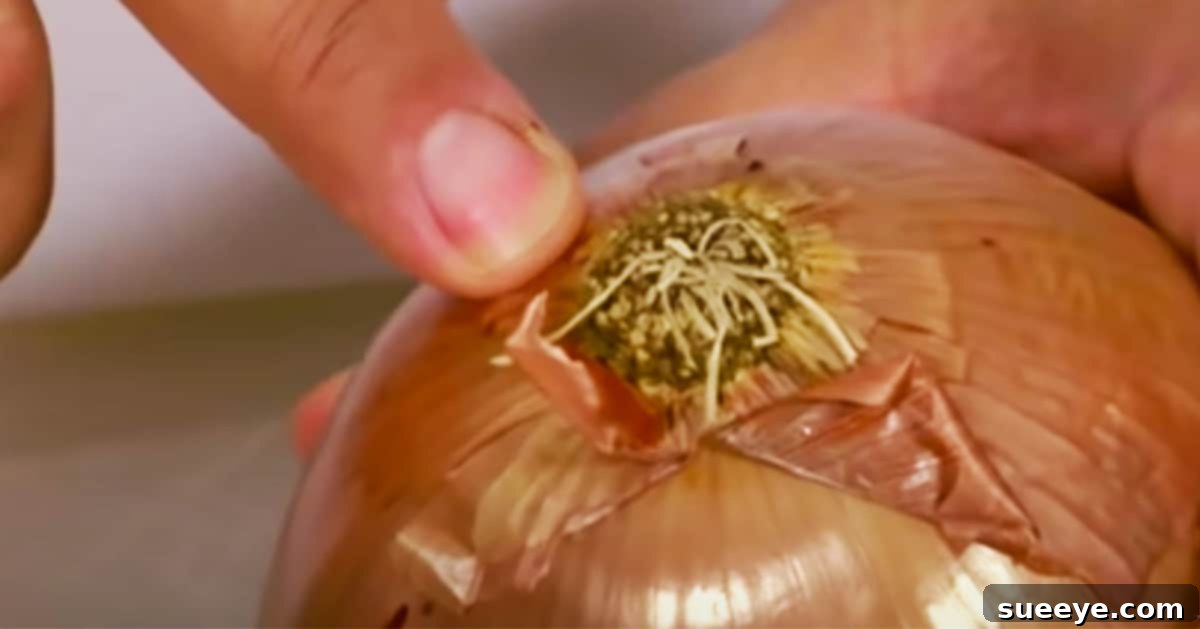
Begin by placing your onion on a cutting board. The critical part to identify is the root end—the small, often fibrous base where the onion’s roots grow. This “bulb of roots” is where a high concentration of the tear-causing compounds resides. Instead of simply slicing off the root, which can still expose some of the irritants, this method calls for a more surgical approach.
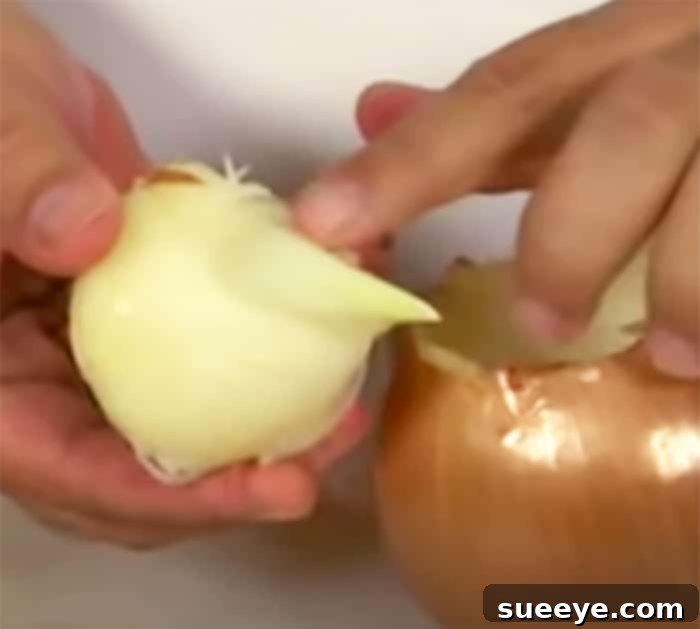
Using a sharp knife, carefully make a circular cut around the diameter of the root end, extending approximately one-third of an inch deep. Imagine carving out a small, shallow cone or inverted pyramid shape from the bottom of the onion. The goal is to encircle and remove the central core of the root without excessively damaging the surrounding onion flesh. Once you’ve made this circular incision, you should be able to pop out the small, cone-shaped piece containing the root bulb. Discard this piece immediately. By physically removing this concentrated source of enzymes, you effectively neutralize the primary trigger for tears.
Step 2: The Correct Way to Slice or Dice Your Onion After Root Removal
Once the root bulb has been successfully removed, the rest of the onion preparation becomes a surprisingly tear-free experience. The method also suggests a specific cutting technique that further minimizes any residual irritation. Instead of cutting the onion on its side or horizontally straight through, which can still release some compounds, a different approach is recommended.
After removing the root, position the onion so that you are cutting from the stem end (the opposite end of where the root was) down towards the cavity where the root used to be. This technique, cutting “from the endpoint down to where the root was,” helps to maintain the onion’s structural integrity longer and directs any minimal gas release downwards, away from your face. From this point, you can chop, dice, or slice the onion to your desired consistency with significantly less, if any, eye irritation. This two-step process—first removing the root, then applying a mindful cutting direction—is a game-changer for anyone who struggles with onion tears.
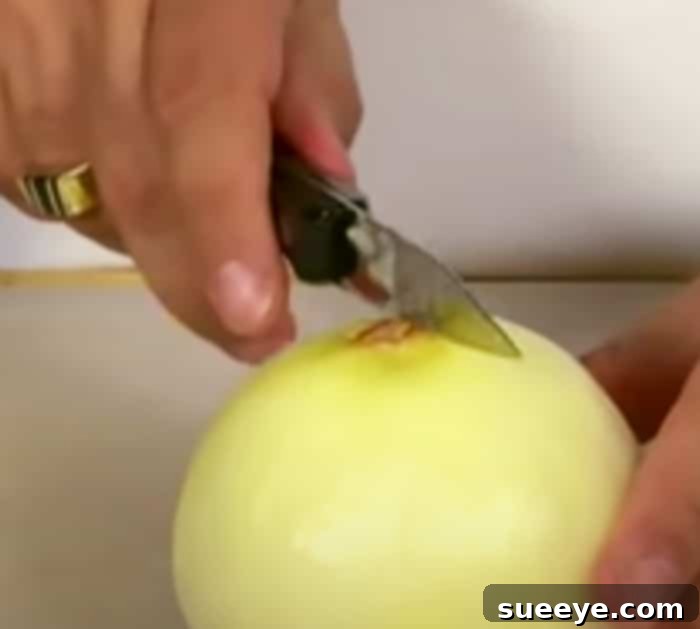
While some might initially perceive removing the root as a “waste” of a small portion of the onion, the benefit of a completely tear-free experience often far outweighs this minor loss. It’s an ingenious hack that tackles the problem at its source, making it one of the most effective methods available.
Beyond the Root: Other Effective Onion-Cutting Hacks
While the root removal method is highly effective, it’s also beneficial to be aware of other popular and practical tips that can help minimize tears. These methods either inhibit the chemical reaction, create a barrier, or help disperse the irritating gas.
Chill Your Onions for a Calmer Cut
One of the most widely recommended and effective methods is to chill your onions before cutting. Placing onions in the refrigerator for at least 30 minutes, or even in the freezer for 15 minutes, significantly slows down the enzyme activity responsible for producing the tear-inducing gas. The cold temperature reduces the volatility of the chemical compounds, making them less likely to become airborne and reach your eyes. This simple pre-prep step is incredibly easy to incorporate into your cooking routine.
Ventilation and Water: Dissipating the Irritants
Creating a good airflow or using water can physically remove or dilute the irritating compounds.
- Cut Near a Vent or Fan: Position your cutting board under a range hood with the fan on high, or near an open window or a small portable fan. The moving air will draw away the tear-causing gas before it has a chance to reach your eyes.
- Cut Under Running Water: While this method can be a bit awkward and messy, cutting onions under a slow stream of running water is highly effective. The water washes away the sulfuric compounds as they are released, preventing them from becoming airborne. Be cautious with your knife skills when working with wet surfaces.
Sharpen Your Knife: Precision Over Pungency
This tip might seem counterintuitive, but a super-sharp knife is your best friend when it comes to tear-free onion chopping. A sharp blade glides through onion cells cleanly, causing minimal damage and rupturing fewer cells. This results in less enzyme and sulfur compound release compared to a dull knife, which crushes and tears the cells, leading to a much greater expulsion of irritants. Investing in good knife sharpening habits pays dividends not only in safety and efficiency but also in minimizing onion tears.
Protective Eyewear: A Simple Barrier
Sometimes, the simplest solutions are the most effective. Wearing a physical barrier between your eyes and the onion can completely block the irritating gas.
- Goggles: Specialized onion goggles are available, but even swim goggles or laboratory safety glasses can do the trick. They create an airtight seal around your eyes, preventing any airborne compounds from reaching them.
Distraction Tactics: Mouth Breathing or Chewing Gum
While not universally effective for everyone, these methods aim to either divert airflow or distract your sensory system.
- Breathe Through Your Mouth: Since the irritating compounds are often inhaled through the nose, breathing exclusively through your mouth can help reduce the amount of gas reaching your nasal passages and subsequently your eyes.
- Chewing Gum or Bread: Some people find that actively chewing gum or a piece of bread while cutting onions helps reduce tears. The theory is that it encourages mouth breathing and potentially keeps your salivary glands active, which might indirectly affect tear production.
The Candle Trick: A Flickering Solution?
This is an old wives’ tale that some swear by, though its scientific basis is often debated. Lighting a candle near your cutting board is thought to burn off the sulfur compounds in the air, preventing them from reaching your eyes. While it might offer a marginal benefit by creating a small updraft of heat, its effectiveness is generally considered less significant than methods like proper ventilation or chilling.
Common Misconceptions and Best Practices for Onion Handling
Beyond specific hacks, a few general best practices can enhance your onion-cutting experience and prevent tears.
- Avoid Rubbing Your Eyes: This seems obvious, but resist the urge to rub your eyes with onion-contaminated hands, as this will only exacerbate the irritation.
- Wash Hands Immediately: After handling onions, wash your hands thoroughly with soap and water to remove any lingering irritants.
- Cut Fresh Onions: Onions that have been stored for a long time or are starting to spoil might release more irritating compounds. Opt for fresh, firm onions whenever possible.
- Minimize Exposure Time: Work quickly and efficiently. The less time your eyes are exposed to the released compounds, the less likely you are to tear up.
Conclusion: Embrace Tear-Free Onion Prep in Your Kitchen
Cutting onions no longer needs to be a dreaded kitchen task that brings tears to your eyes. By understanding the science behind why onions make us cry, and by adopting effective techniques, you can transform your cooking experience. The root removal method, as highlighted by the “Cooking With Jack Show,” offers a remarkably effective, proactive solution to eliminate the primary source of irritation. Coupled with other smart hacks like chilling your onions, using a sharp knife, or ensuring good ventilation, you have a powerful arsenal against onion tears.
Experiment with these tips to find what works best for you. Whether you’re a seasoned chef or a novice home cook, mastering tear-free onion preparation is a valuable skill that enhances both your efficiency and enjoyment in the kitchen. Say goodbye to the burn and the tears, and welcome effortless, comfortable onion chopping into your culinary repertoire. Happy cooking!