
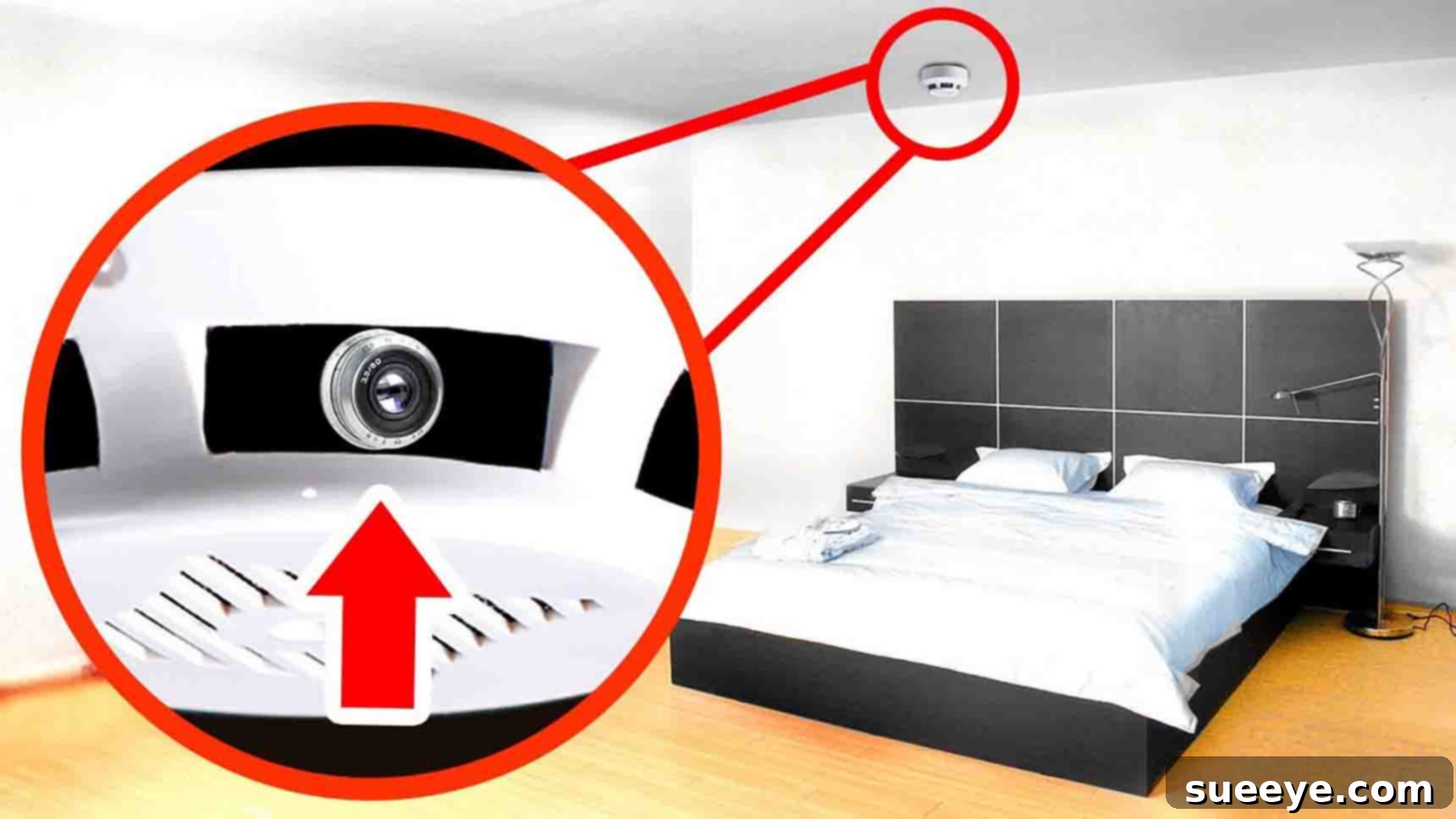
In an increasingly connected world, privacy has become a paramount concern, especially when we are in private spaces like hotel rooms, vacation rentals, or Airbnbs. The thought of being secretly watched by hidden cameras can be unsettling and compromise your sense of security. As a seasoned traveler myself, I understand this apprehension firsthand. That’s why I’ve honed efficient methods to meticulously check every nook and cranny of any room I’m staying in, ensuring peace of mind.
This comprehensive guide will equip you with practical, easy-to-follow techniques to detect hidden cameras, helping you protect your personal space and privacy. We’ll explore various methods, from simple visual inspections to utilizing the technology readily available in your smartphone. Originally inspired by valuable insights from BRIGHT SIDE on Youtube, these strategies have become my go-to for ensuring a safe and secure stay. Let’s delve into these essential steps to empower you against potential intrusions.
Ultimate Guide: 8 Ways to Detect Hidden Cameras in Any Place You Stay
1. Conduct a Thorough Visual Inspection of Obvious and Suspicious Spots
The first line of defense against hidden cameras is a meticulous visual sweep of your surroundings. While covert devices are designed to be inconspicuous, they often rely on specific placements to get a good view. Begin by systematically scanning the room for anything that looks out of place or offers an ideal vantage point for surveillance. Focus on areas that provide a clear line of sight to beds, bathrooms, or dressing areas.
Common hiding spots include smoke detectors, alarm clocks, tissue boxes, air vents, lamps, picture frames, and even electrical outlets. Look for tiny pinholes, misplaced objects, or devices that seem unusually positioned. Pay attention to items that might offer a wide-angle view of the room. A slightly askew decorative item or an alarm clock facing an odd direction could be a tell-tale sign. Remember, hidden cameras need a lens opening, no matter how small. Take your time and be observant; sometimes, the most obvious spots are overlooked in haste.
2. Utilize Your Smartphone’s Flashlight for Lens Reflection Detection
Every camera, no matter how small, has a lens, and all lenses reflect light. This basic principle forms the foundation of one of the simplest yet most effective detection methods using your smartphone’s flashlight. To perform this sweep, first, create an environment of maximum darkness in your room. Close all curtains, turn off all lights, and ensure minimal ambient light.
Once the room is dark, switch on your phone’s flashlight. Slowly pan the light across potential hiding spots and objects, maintaining a steady pace. Hold your phone at eye level and look for any tiny, distinct reflections – a small red or blue gleam, or a pinpoint of light that stands out against the darkness. This reflection is the light bouncing off a camera lens. Common areas to thoroughly check include smoke detectors (often a prime spot for covert cameras), alarm clocks, mirrors, picture frames, decorative items, and any small holes in walls or furniture. Since the light needs to strike the lens at the correct angle to reflect back to your eyes, execute this scan slowly and deliberately, checking from multiple angles if necessary. This method is particularly effective for detecting “pinhole” cameras that are otherwise nearly impossible to spot.
3. Detect Infrared (IR) Emitters Using Your Smartphone Camera
Many hidden cameras, particularly those designed for night vision or low-light conditions, emit infrared (IR) light. While human eyes cannot perceive IR light, your smartphone camera often can. This provides another ingenious way to uncover concealed surveillance devices.
To perform this check, turn off all the lights in the room to create complete darkness. Then, open your smartphone’s camera app. For most smartphones, the rear-facing camera has an infrared filter, which might block some IR light, but the front-facing (selfie) camera typically does not. Switch to selfie mode for the most reliable results. You can test this method by pointing a TV remote control at your front-facing camera and pressing any button; if it’s working, you should see a bright red or purple light flickering on your screen, indicating the remote’s IR signal.
Once confirmed, slowly pan your front-facing camera around the dark room, especially towards areas you suspect might harbor a hidden camera. Look for any bright, pulsating, or steady light sources on your phone screen that are invisible to the naked eye. These bright spots could be the infrared LEDs of a night-vision camera. Common targets for IR cameras include smoke detectors, air vents, and any small electronics. This method is highly effective for spotting cameras that are actively using IR illumination.
4. Employ Network Scanners and RF Detectors for Connected Devices
Many modern hidden cameras are “IP cameras” that connect to a Wi-Fi network to stream footage. You can leverage this fact by using network scanning applications on your smartphone. Apps like “Fing,” “IP Tools,” or similar network analyzers can scan the Wi-Fi network you’re connected to and list all devices currently online.
After downloading a reputable network scanner app, connect your phone to the room’s Wi-Fi. Run the scan and look for unfamiliar devices, especially those labeled as “IP Camera,” “Webcam,” or with generic manufacturer names (like “D-Link,” “Hikvision,” “Axis”) that don’t correspond to known hotel equipment (e.g., smart TVs). While this method is excellent for Wi-Fi-connected cameras, it won’t detect cameras that record locally or transmit via other means.
For a more robust solution, especially for wireless cameras not connected to the local Wi-Fi, consider a dedicated Radio Frequency (RF) detector or bug detector. These specialized devices can pick up on electromagnetic frequencies emitted by wireless cameras, even if they operate on their own network. While RF detectors are a more advanced tool and might require purchase, they offer a wider detection range for various wireless surveillance devices, providing an extra layer of security.
5. The Strategic Wi-Fi Disconnection Test
This method is less about direct detection and more about revealing suspicious behavior. Many hidden IP cameras rely on an active Wi-Fi connection to function, especially if they are streaming live footage or storing data remotely. By deliberately disrupting this connection, you might inadvertently expose a hidden device or trigger an unusual reaction from the establishment.
When you first enter your hotel room or rental, consider turning off the Wi-Fi router for a short period (if accessible and appropriate for the rental type) or simply disconnecting all your personal devices from the Wi-Fi. If, shortly after doing so, you receive an unexpected call from the reception or host inquiring about the Wi-Fi being “down” in your room, consider it a potential red flag. There would typically be no legitimate reason for them to know you’ve purposely turned off the Wi-Fi or that the connection is momentarily disrupted unless a connected device, such as a camera, has alerted them to a loss of signal. This could indicate that cameras are indeed present and relying on the local Wi-Fi for operation. While not foolproof, it’s a clever psychological test that might reveal an unauthorized surveillance setup.
6. Listen for Subtle Mechanical Noises
Some advanced hidden cameras, especially those with pan, tilt, or zoom (PTZ) capabilities, contain small motors that can produce faint mechanical sounds. While often designed to be silent, in a very quiet room, you might be able to detect a subtle whirring, clicking, or buzzing sound.
To perform this test, turn off all background noise sources in the room – this includes TVs, radios, air conditioning, and even buzzing refrigerators if possible. Then, sit in silence and listen intently. Slowly move around the room, pausing in various locations, and focus your hearing on areas where cameras might be concealed, such as vents, smoke detectors, or ceiling fixtures. While this method isn’t guaranteed to detect all cameras, particularly static ones, it can be surprisingly effective for uncovering more sophisticated, movable surveillance devices that might be actively repositioning their view.
7. Check Mirrors and Reflective Surfaces for Two-Way Properties
A common tactic for hidden camera placement is behind two-way mirrors, which look like regular mirrors from one side but allow observation from the other. You can perform a simple test to determine if a mirror is a standard mirror or a two-way one.
Place your fingertip directly on the surface of the mirror. If there’s a gap between your fingertip and its reflection, it’s a standard mirror (the reflection is behind the glass). However, if your fingertip touches its reflection directly with no gap, it might be a two-way mirror. This happens because a two-way mirror has its reflective coating on the surface, allowing light to pass through from the darker side. Also, try shining a bright flashlight directly at the mirror in a darkened room. If it’s a two-way mirror, you might be able to see through to the other side, revealing a hidden space or even a camera lens. Always be suspicious of mirrors in unusual locations or those that seem out of place.
8. Conduct a Physical Inspection for Loose Wires and Unexplained Devices
Beyond just looking for camera lenses, a more thorough physical inspection can often reveal tell-tale signs of a covert setup. Get down and look behind furniture, under tables, and inside drawers. Feel around for any loose or strangely routed wires that don’t seem to belong to the visible electronics. Hidden cameras often require power, and poorly concealed wiring can give them away.
Carefully inspect power adapters, USB chargers, and other small electronic devices. Some hidden cameras are disguised as common household items. Feel the temperature of these devices; if a small charger is unusually warm when nothing is plugged into it, it might be running an internal camera or recording device. Don’t hesitate to gently move light furniture or open cabinet doors to check hidden corners. Look for signs of tampering, such as fresh drill holes, discolored paint patches, or new plaster around vents or fixtures. A thorough physical search, combined with the other techniques, significantly increases your chances of finding any unwelcome surveillance.
What to Do if You Find a Hidden Camera
If you suspect or confirm the presence of a hidden camera, your immediate action is crucial.
- Do Not Touch or Tamper: Avoid touching or moving the device, as you might destroy evidence.
- Document Everything: Take photos and videos of the camera and its location.
- Cover the Lens: If you can’t leave immediately, cover the camera’s lens with tape, a cloth, or anything opaque to ensure your privacy.
- Contact Authorities: Immediately report your findings to the local police. This is a serious invasion of privacy and a potential crime.
- Inform the Management/Platform: If it’s a hotel or Airbnb, inform the management or the platform (e.g., Airbnb customer support). They should be made aware and take appropriate action.
- Seek New Accommodation: Prioritize your safety and peace of mind by finding alternative accommodation.
Conclusion: Empowering Your Travel with Enhanced Privacy
Traveling should be an exciting and relaxing experience, not one clouded by concerns about privacy. While the idea of hidden cameras can be alarming, equipping yourself with these practical detection methods can significantly boost your confidence and security. From leveraging your smartphone’s basic features to performing diligent physical inspections, you now have a comprehensive toolkit to safeguard your personal space.
Remember, vigilance is key. Take a few minutes upon arrival to perform these checks, especially in sensitive areas like bedrooms and bathrooms. Your privacy is invaluable, and by taking these proactive steps, you can ensure that your hotel room or rental remains truly your own private sanctuary. Stay safe, stay aware, and enjoy your travels with complete peace of mind.